

The Benefits of Memorizing the Qur'an in Daily Life
Memorizing the Qur'an changes far more than your prayer. Here are the real spiritual, mental, and everyday benefits of hifz — with authentic references and honest expectations.
Most people think of hifz as a project with an end date — years of effort, then a certificate and a title. But ask anyone who has actually walked the path and they'll tell you something different: the benefits show up long before you finish, and they show up in ordinary life.
Not just in Ramadan. Not just in the masjid. In how you pray, how you handle a hard week, how you spend the quiet minutes of your day.
Here's an honest look at what memorizing the Qur'an actually does for you.
Your prayer stops being autopilot
This is the change people notice first, and it's the one they mention most.
Many of us pray with the same three or four short surahs for years. The words come out, but the mind wanders — to work, to a conversation, to the phone. Salah becomes a routine you perform rather than a conversation you're in.
When you have more of the Qur'an memorized, prayer opens up:
- You can recite different passages each day, so the words stay fresh instead of turning into background noise.
- You can choose what fits your state — a passage about mercy on a heavy day, a passage about gratitude on a good one.
- Your prayers naturally lengthen, not out of obligation, but because you have something to say.
The Prophet ﷺ said: "The best of you are those who learn the Qur'an and teach it." (Sahih al-Bukhari 5027). That learning begins with carrying the words yourself.
You always have the Qur'an with you
A mushaf can be left at home. A phone can run out of battery. What you've memorized travels with you everywhere — on a commute, in a hospital waiting room, during a sleepless night at 3am.
This is the quiet, practical benefit that huffaz describe most warmly. The empty moments of the day — walking, waiting, washing dishes — stop being empty. They become time you can fill with revision, and revision is recitation.
For many people, this alone transforms their relationship with the Qur'an from something scheduled to something constant.
The reward is real and specifically promised
The virtues of carrying the Qur'an are established in authentic narrations. A few worth knowing:
- Every letter counts. The Prophet ﷺ said: "Whoever recites a letter from Allah's Book, then he receives the reward from it, and the reward of ten the like of it. I do not say that Alif Lam Mim is a letter, but Alif is a letter, Lam is a letter and Mim is a letter." (Jami' at-Tirmidhi 2910, graded sahih by al-Albani)
- The Qur'an intercedes. "Recite the Qur'an, for on the Day of Resurrection it will come as an intercessor for those who recite it." (Sahih Muslim 804a)
- Status is raised by it. "Verily, Allah raises the status of people by this Book, and by it He humbles others." (Sahih Muslim 817)
Note the wording — those who recite it, in the present tense. The promise attaches to people who keep returning to the Qur'an, not to those who visited it once. That's exactly the habit hifz builds.
It builds discipline that spills into everything else
Hifz is, in practical terms, a daily commitment you keep whether or not you feel like it. You memorize a few lines. You revise yesterday's. You cycle through older pages. Every single day.
That habit doesn't stay inside your hifz:
- Focus improves. Holding verses in your head requires sustained attention — a genuinely rare skill in an age of constant interruption.
- Consistency becomes normal. Once you've kept a daily promise to yourself for six months, other daily habits get easier.
- Patience grows. Progress in hifz is slow and unglamorous. Learning to value small daily gains changes how you approach everything else.
Many students report that their schoolwork or professional work improved after starting hifz — not because memorization is magic, but because they'd trained the underlying habit.
It steadies you in hard times
Life brings loss, anxiety, and stretches where nothing goes right. In those moments, what you've memorized becomes something you can reach for immediately.
Allah says: "Verily, in the remembrance of Allah do hearts find rest." (Qur'an 13:28)
There's a difference between reading a verse of comfort and having it — being able to recite it in the dark without reaching for anything. Huffaz consistently describe this as the benefit they didn't expect and came to value most.
You start to understand what you're saying
This one is worth being precise about, because it's often overstated: memorizing Arabic does not automatically make you understand Arabic.
But it does something real. Repetition puts thousands of Arabic words into your long-term memory. Over time you begin recognizing roots and patterns across surahs. When you then study translation or basic Arabic, the vocabulary is already familiar — you're attaching meaning to words you know rather than learning both at once.
Hifz doesn't replace studying meaning. It makes studying meaning dramatically easier.
A note on honest expectations
Because it matters: hifz is demanding. Anyone who tells you otherwise is selling something.
- It takes years, not months, for the full Qur'an.
- Forgetting is normal and constant — protecting what you memorize is the real work.
- There will be weeks where you make no visible progress.
The benefits above are genuine, but they're earned through consistency, not intensity. A student doing fifteen honest minutes daily for three years will be far ahead of someone who does three-hour sessions for two months and burns out.
Common mistakes people make about the benefits
- Chasing the title, not the relationship. Aiming to "be a hafiz" rather than to live with the Qur'an leads to rushed memorization that fades.
- Neglecting quality for quantity. Pages memorized with poor tajweed have to be relearned. Slower and correct beats fast and broken.
- Assuming benefits arrive at the finish line. They don't. They start in month one — if you're consistent.
- Memorizing without revising. This is the single most common failure, and it undoes everything.
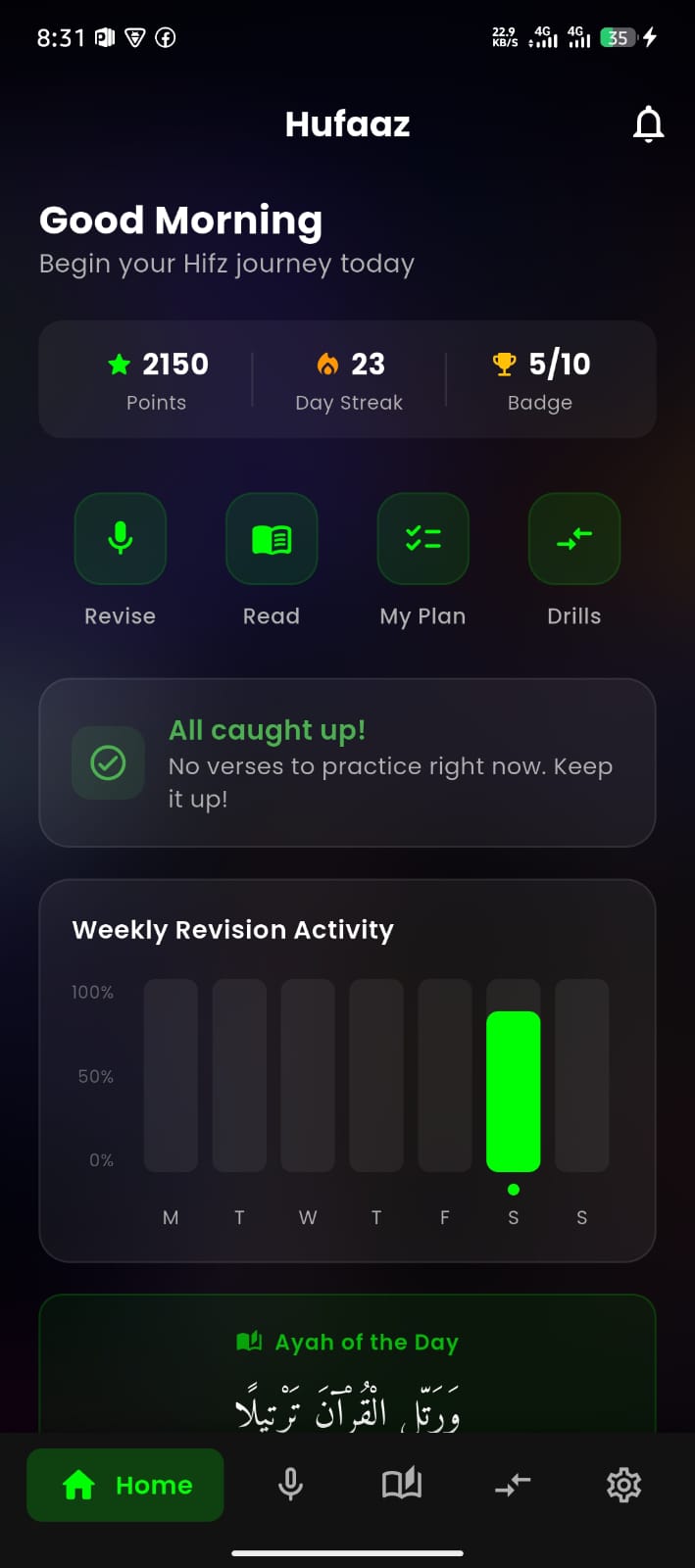
Consistency is where most people struggle — not motivation. Hufaaz helps here: you recite out loud, the app listens and catches the exact word you slip on, then plays it back correctly in your chosen Qari's voice. It also schedules your revision so old pages resurface before you'd forget them.
Frequently asked questions
Do I need to memorize the whole Qur'an to benefit? No. Every juz, every surah, every page brings its own benefit. Many people memorize Juz Amma and a few longer surahs and find their prayer completely transformed. Start where you are.
I'm an adult with a job. Is it too late? It isn't. Adults memorize successfully all the time, and they bring an advantage children don't have: they understand meaning, which helps verses stick. The approach differs — see how to start hifz as an adult.
What if I keep forgetting what I memorize? That's normal and expected — it's not a sign you're bad at hifz. Forgetting is fixed by review, not by memorizing harder. A structured revision schedule is the solution.
Does memorizing without understanding Arabic still count? Yes. The reward for reciting the Qur'an is not conditional on knowing Arabic. That said, pursuing meaning alongside memorization deepens the experience considerably, and hifz makes that study much easier.
How much time per day do I realistically need? For steady progress, 30–45 minutes covering new memorization plus review. For maintaining what you already have, 15–20 focused minutes daily can be enough. Consistency matters far more than session length.
Will hifz help my child academically? It often helps with focus and study discipline, and many parents observe this. But treat that as a welcome side effect, not the goal — children sense when the Qur'an is being used as a study tool, and it changes their relationship with it.
Is it better to memorize fast or slowly? Slowly, almost always. Pages memorized carefully with correct pronunciation stay. Pages rushed through need to be relearned later, which costs more time than going slowly would have.
The benefits of hifz aren't reserved for the day you finish. They arrive in your next prayer, in the twenty quiet minutes of tomorrow's commute, in the week when everything is hard and you have something to hold onto.
Start small, stay consistent, and protect what you memorize. That's the whole method.
If you want a companion that listens while you recite, corrects you gently in a Qari's voice, and tells you exactly what to revise each day, Hufaaz is free on Google Play.