
Online Hifz Classes vs Traditional Madrasah: Which Is Right for You?
An honest comparison of online Hifz classes and traditional madrasah — cost, discipline, teacher access, social environment — plus how to decide which fits your family's situation.
A generation ago this wasn't a question. If you wanted to memorize the Qur'an, you went to a madrasah — or you didn't memorize.
Today most families have a genuine choice, and it's not obvious which way to go. Online programs are more accessible and flexible; traditional madrasahs offer immersion and structure that's hard to reproduce on a screen.
Neither is better in the abstract. What matters is which one fits your student, your family, and your circumstances. Here's an honest comparison.
What each one actually is
Traditional madrasah — in-person learning with a qualified teacher, usually in a group, often daily. Ranges from after-school halaqahs a few hours a week to full-time residential hifz programs where memorization is the primary occupation for two to four years.
Online hifz classes — one-to-one or small-group sessions with a teacher over video, typically 30–60 minutes, several times a week. The student memorizes at home and recites to the teacher during the session.
There's a third path worth naming, because many people are actually on it: self-study with tools — memorizing independently using recordings, apps, and structured schedules, with occasional or no teacher contact. Cheapest and most flexible, hardest to sustain, and the one where correction is most likely to be missing.
Side by side
| Traditional madrasah | Online classes | |
|---|---|---|
| Teacher access | Continuous, in person | Scheduled sessions only |
| Correction quality | Immediate, full context | Good, limited by audio |
| Discipline | External structure | Depends on the student |
| Flexibility | Low — fixed schedule | High — fits around work/school |
| Cost | Varies; often low or free locally | Usually monthly fees |
| Travel | Daily commute | None |
| Peer environment | Strong — classmates, competition | Weak or absent |
| Teacher choice | Whoever is local | Wide selection, any qualification |
| Pace | Class pace | Individual pace |
| Adab and character | Learned by presence | Harder to transmit |
Where traditional madrasah is genuinely stronger
Discipline you don't have to generate yourself. This is the biggest advantage and it's often underrated. You show up because it's time, the teacher is waiting, and your classmates are there. Most people — children especially — sustain far more consistency inside external structure than they can manufacture alone.
Correction is continuous. The teacher hears not just your recitation but your hesitations, your posture, whether you're actually looking at the page. They catch the habit forming, not just the error.
The peer effect is real. Memorizing alongside others who are memorizing changes what feels normal. A student who sees three classmates finish a juz this month experiences a pull that no app produces.
Adab is transmitted by presence. How you sit with the Qur'an, how you treat a teacher, the seriousness of the environment — these are absorbed rather than taught. It's the hardest thing to reproduce remotely.
Immersion. In a full-time program, hifz is the day's purpose, not something squeezed between other obligations. Completion rates reflect this.
Where online classes are genuinely stronger
It exists where a madrasah doesn't. For families in areas without a qualified hifz teacher, online isn't the inferior option — it's the only option. That alone settles the question for many people.
You choose the teacher. Local means whoever is local. Online means you can find a teacher with the right qualification, the right language, the right temperament for your child, and match a female teacher to a female student if that matters to your family.
It fits real adult lives. A working adult cannot attend a daily madrasah. A 45-minute session before work, three times a week, is achievable — and achievable beats ideal. See how to start hifz as an adult.
Individual pace. In a class, you move with the group — frustrating if you're faster, crushing if you're slower. One-to-one means the pace is yours.
No commute. Forty minutes of daily travel is forty minutes not spent memorizing. Over years, that's substantial.
Recorded sessions. Many programs record, so a student can re-hear exactly how the teacher corrected them. No madrasah offers that.
The honest weaknesses of each
Traditional madrasah:
- Quality varies enormously — a weak local teacher is worse than a strong remote one
- Fixed schedules exclude many working adults entirely
- Class pace suits the middle of the group, not the ends
- In some settings, harsh discipline damages the child's relationship with the Qur'an — worth checking carefully before enrolling
- Full-time residential programs are a major commitment with real trade-offs for general education
Online classes:
- Discipline is entirely on you. Between sessions, nobody is watching. This is where most online hifz quietly fails.
- Audio quality limits fine tajweed correction — subtle articulation points are harder to catch over a compressed connection
- Screen fatigue is real, particularly for younger children
- No peer group, so no social momentum
- Quality varies as much as it does offline; credentials are harder to verify remotely
- Young children often struggle to stay engaged with a teacher on a screen
How to actually decide
Work through these in order — the first clear answer usually settles it.
1. Is there a good local option? Not just a madrasah — a good one, with a teacher you'd trust with your child's relationship with the Qur'an. Visit. Watch a session. If yes, and the schedule works, in-person is usually the stronger default, especially for children.
2. How old is the student? Under about ten, in-person tends to work better — young children engage more with a present adult. Teens and adults do well online. Very young children in online sessions need a parent physically sitting with them.
3. How self-directed is the student? Online demands independent daily work between sessions. If the honest answer is "they won't do it unless someone is there," that's decisive information, not a character flaw.
4. What does the schedule allow? A working adult or a student with heavy school commitments often has only one realistic option. Consistency over years beats a superior format you can't attend.
5. What can you sustain financially? Hifz takes years. A cheaper program you can maintain for three years is worth more than an excellent one you drop after eight months.
What matters more than the format
This is the part most comparisons miss. Both paths succeed or fail on the same three things:
- Daily consistency. Neither format memorizes for you. The student who does twenty honest minutes every day outperforms the one enrolled in the better program who shows up sporadically.
- Correction. Errors that go unnoticed become permanent. Whatever the format, something must be catching mistakes regularly — a teacher, a partner, or a tool.
- Review. More hifz is lost to neglected review than to bad teaching. A structured revision schedule matters more than which format delivered the lesson.
Get those three right and either path works. Get them wrong and neither does.
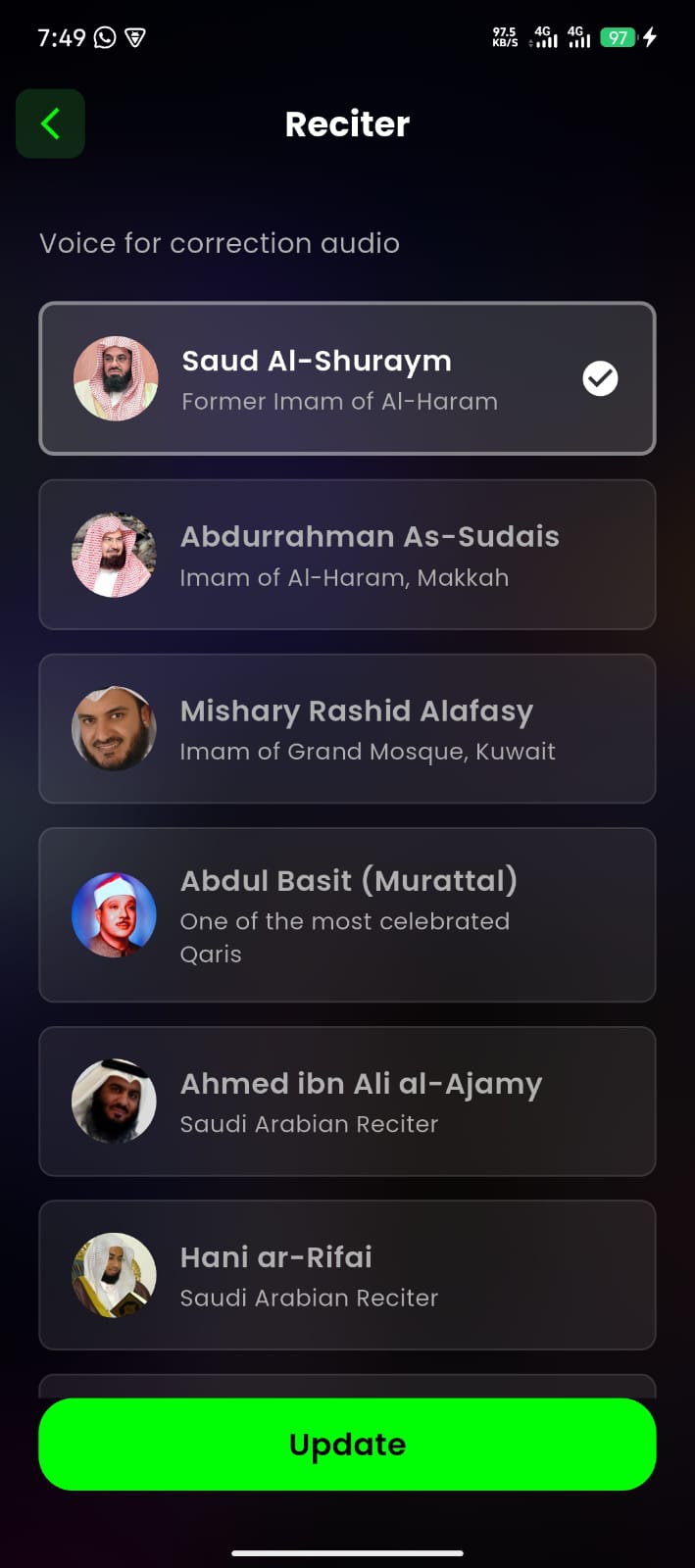
Whichever route you take, the days between lessons are where hifz is actually won or lost — and that's the gap most students face alone. Hufaaz is built for exactly that: you recite out loud, it catches the exact word you slipped on and plays it back correctly in your chosen Qari's voice, and it schedules your revision so pages resurface before you'd forget them. It complements a teacher rather than replacing one.
Common mistakes when choosing
- Assuming online means easier. It usually demands more self-discipline, not less.
- Choosing on price alone. The cheapest teacher who doesn't correct properly costs years.
- Not verifying the teacher's ijazah or qualification. Ask directly. Reputable teachers expect the question.
- Enrolling without a trial. Almost every online program offers one. Use it, and watch a real session.
- Ignoring the student's own preference. A teenager forced into a format they resent will find a way not to do the work.
- Treating enrolment as the finish line. Enrolment is the easy part. The daily work at home decides the outcome.
Frequently asked questions
Can you really become a hafiz online? Yes — many have. It requires more self-discipline and a committed daily routine, but the format doesn't limit the outcome. Consistency and correction do.
Is online tajweed correction good enough? For most students, yes. A good connection with decent audio lets a teacher catch the great majority of errors. The finest articulation points are genuinely easier in person, so if precision-level tajweed is your goal, in-person has an edge.
What age is too young for online classes? Children under about seven usually struggle to engage with a screen-based teacher for a full session. If you go online with a young child, plan for a parent to sit with them each time.
How much do online hifz classes cost? It varies widely by teacher, region, and session length. Get quotes from several providers and, critically, ask what the monthly commitment looks like over a multi-year timeframe — not just the introductory rate.
Can I combine both? Yes, and it's often the strongest option: a local halaqah for community, structure, and adab, plus an online teacher for one-to-one correction — or a self-study tool covering daily practice between lessons.
What should I look for in an online teacher? Verified qualification (ideally an ijazah), experience with your student's age group, a shared language you can both communicate in comfortably, clear expectations about homework, and a trial session before committing.
What if we start one and it isn't working? Switch. Give it a fair run — two or three months — but a format or teacher that isn't working won't improve by persistence alone. Many successful huffaz changed paths at least once.
There's no universally correct answer. A good local madrasah is hard to beat for children, especially where discipline and community matter. Online classes are the better fit for adults, for anyone without local access, and for students who need a specific teacher or a flexible schedule.
What both require is the same: daily work, honest correction, and relentless review. Choose the format that makes those three easiest for your actual life — not the one that sounds most impressive.
If you want support for the days between lessons, Hufaaz is free on Google Play — it listens while you recite, corrects you in a Qari's voice, and keeps your revision on schedule.