
The Best Time of Day to Memorize Qur'an (And Why It's Not the Same for Everyone)
After Fajr is the classic answer — but it isn't the only one. How to find the hour your memory actually works best, and why the time you keep beats the time that's ideal.
Almost everyone gives the same answer to this: after Fajr. And it's a good answer — the classical scholars favoured it, the mind is rested, and the house is quiet.
But it isn't the whole answer, and treating it as the only correct one has quietly stopped a lot of people from memorizing at all. If your working day starts at six, or you have a newborn, or you simply cannot think clearly before eight, "after Fajr" isn't advice — it's a reason to give up.
So this article splits the question in two. First: what makes a time genuinely good for memorization. Second: how to find yours, which may not be the one in the books.
Why after Fajr earns its reputation
Three things make the hour after Fajr unusually effective, and they're worth naming because they're the criteria you'll use to judge any other slot.
Your mind is clearest. You haven't yet spent the day making decisions, absorbing messages, or solving problems. New memorization is demanding work, and it goes in easiest when nothing else is competing for attention.
Nothing interrupts. No calls, no messages, nobody needing anything. Memorization is destroyed by interruption more than by tiredness — every break means restarting the passage.
It's already fixed. You're awake for Fajr anyway. A memorization slot attached to something that already happens daily is far harder to lose than one floating in the afternoon.
Notice that only the first of these is about the time of day. The other two are about quiet and reliability — and those are available at other hours too.
What actually makes a slot good
Judge any candidate time against these four, in order:
- Are you mentally fresh? Not necessarily "morning" — fresh for you. Some people's clearest hour is 10pm.
- Will you be uninterrupted for the whole slot? Twenty protected minutes beat an hour that gets broken three times.
- Does it happen at the same time every day? Consistency is what turns a slot into a habit.
- Can you attach it to something already fixed? A prayer, a commute, the moment the children fall asleep.
A slot that scores well on all four will outperform "after Fajr" if Fajr doesn't work for your life. And a slot that fails on interruption or consistency will underperform, no matter how classical the hour.
New memorization vs review — different needs
Here's a distinction that solves the problem for most people with difficult schedules: new memorization and review don't need the same conditions.
New memorization needs your best hour. It's the hardest cognitive work in hifz — full attention, no distraction, a rested mind.
Review is far more forgiving. Once a page is memorized, revisiting it is closer to a physical skill than a mental puzzle. It survives tiredness, noise, and interruption remarkably well. You can review while walking, commuting, cooking, or lying in bed.
This means you don't need one long perfect block. You need one short protected slot for new pages, and scattered minutes for review. That's a schedule almost anyone can build. Our daily routine guide works through how the pieces fit together.
Four times that work (pick the one that fits)
After Fajr
Best for: most people, if it's realistically available.
The classic choice, and genuinely the strongest on all four criteria — provided you can sleep early enough that you're rested rather than exhausted. Memorizing while fighting to stay awake is worse than memorizing at a later hour fully alert. If you're up for Fajr and immediately back to bed, this isn't yet your slot; fix your sleep first.
Before Fajr (the last third of the night)
Best for: those who already pray tahajjud, or naturally wake early.
Quieter still, and the blessing of that time is well established. But it demands a sleep schedule that supports it. If waking at 3am costs you an alert morning, you've moved the problem rather than solved it.
Mid-morning, after the day has started
Best for: students between classes, people working from home, parents after school drop-off.
Less traditional, but it scores well: you're properly awake, the household has settled, and if it's tied to a fixed event — the school run finishing, a set break — it's reliable. Many working adults find this beats a groggy pre-dawn attempt.
After Isha, before sleep
Best for: working adults and night-inclined people.
The one advantage here is unique: what you memorize immediately before sleeping tends to settle well. Sleep is when memory consolidates, and giving new material a short gap before it is genuinely useful.
The risk is equally real. By Isha your attention is depleted, and it's easy to sit with the mushaf while absorbing nothing. If you use this slot, keep it short and honest — twenty focused minutes, not an hour of drifting.
How to actually find your hour
Rather than guessing, test it. This takes a week:
- Pick two candidate slots from the list above that are realistic for your life.
- Give each three days. Same portion length, same conditions.
- Record two things daily: how long the portion took, and how much of it you still had the next morning.
- Compare. The winner is the slot where the same amount of work stuck better.
That second measurement matters more than how the session felt. A session can feel productive and leave nothing by morning. Retention the next day is the only real test.
The rule that overrides all of this
Every point above is secondary to one thing: the best time is the one you will actually keep.
A theoretically perfect slot you hit twice a week loses badly to a mediocre slot you hit daily. Hifz is built by accumulation — the same page revisited on schedule, month after month. Consistency isn't a nice-to-have that supports the method; consistency is the method.
So if you find yourself choosing between the ideal hour you'll miss half the time and a decent hour you'll keep, take the decent one. You can improve the slot later. You cannot recover the months lost waiting for a perfect schedule to appear. (If keeping the habit is the part that keeps breaking, staying consistent and motivated tackles that specifically.)
Frequently asked questions
What is the best time of day to memorize Qur'an? For most people it's the hour after Fajr — the mind is rested, the house is quiet, and you're already awake for the prayer. But the genuinely best time is whichever hour leaves you mentally fresh, uninterrupted, and able to show up daily. That isn't dawn for everyone.
Is it bad to memorize Qur'an at night? Not at all. Memorizing shortly before sleep has a real advantage, since sleep is when memory consolidates. The risk is depleted attention — by late evening it's easy to sit with the mushaf while absorbing little. Keep night sessions short and honest rather than long and drifting.
Should I memorize before or after Fajr? After Fajr suits most people, because you're awake for the prayer anyway and the slot needs no extra sacrifice. Before Fajr is excellent for those already praying tahajjud or naturally waking early, but only if your sleep schedule genuinely supports it.
Can I memorize Qur'an if I only have time in the evening? Yes. Reserve your freshest available slot for new memorization and spread review through the day, since review survives tiredness and interruption far better than new material does. Many working adults memorize entirely on evening schedules.
Does the time of day really affect memorization? It affects how easily new material goes in, mainly through alertness and freedom from interruption. But it matters far less than consistency: a good hour kept daily beats an ideal hour kept twice a week, because hifz is built by accumulation rather than by any single session.
How do I find the best time for me? Test two realistic slots for three days each, keeping the portion size the same. Record how long it took and how much you still had the next morning. Retention the following day is the real measure — a session can feel productive and leave nothing behind.
Should new memorization and review happen at the same time? They don't have to, and separating them helps if your schedule is tight. New memorization needs your clearest, most protected slot. Review is far more forgiving and can fill scattered minutes while commuting, walking, or before sleep.
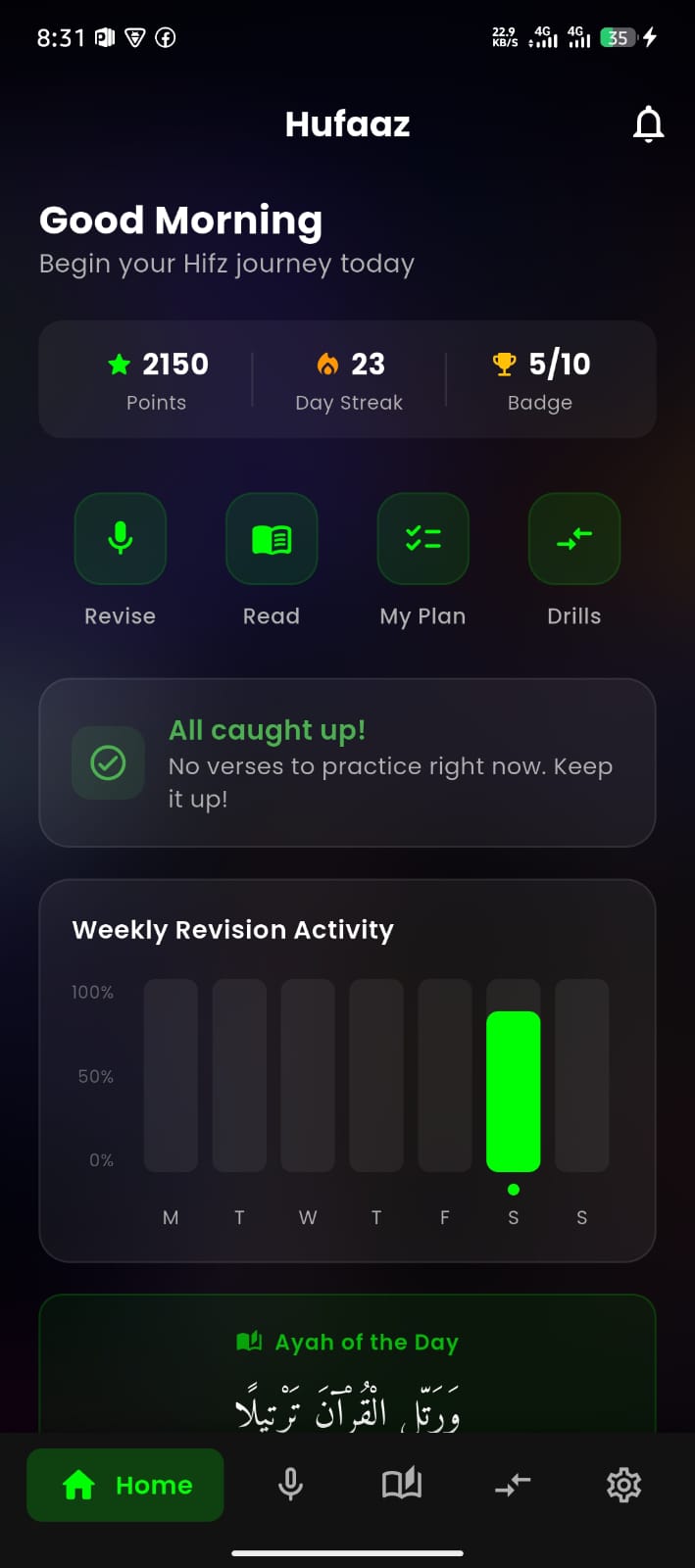
Once your slot is fixed, the remaining question is which pages are due — and that's the part most people get wrong, reviewing what feels familiar instead of what's actually slipping. Hufaaz tracks that for you, brings weak pages back sooner, and corrects the exact word you slip on in your chosen Qari's voice.
Conclusion
After Fajr deserves its reputation, and if you can make it work, make it work. But the criteria behind it — a clear mind, no interruptions, and a fixed daily anchor — can be met at other hours, and for many people they have to be.
Test two slots. Measure what you still have the next morning, not how the session felt. Then protect the winner and stop reconsidering it.
If you'd like something to handle what's due while you handle showing up, Hufaaz is free on Google Play. May Allah put barakah in whichever hour you give Him.