
Common Mistakes During Hifz and How to Avoid Them
Most people don't fail at hifz because it's too hard — they fail because of a handful of avoidable mistakes. Here are the ten most common, why they happen, and exactly how to fix each one.
Very few people abandon hifz because memorizing the Qur'an is beyond them. They abandon it because of a small number of specific, fixable mistakes — usually the same ones, in roughly the same order.
The encouraging part: once you can name them, most are straightforward to correct. Here are the ten that derail hifz most often.
1. Memorizing far more than you review
This is the mistake that ends more hifz journeys than all the others combined.
New pages feel like progress. Review feels like standing still. So people push forward, and six months later discover that everything from months one and two is gone. They conclude they have a bad memory and stop.
Why it happens: Adding pages is measurable and satisfying. Review isn't.
How to fix it: Flip your ratio. Roughly one third of your session on new material, two thirds on review. If you're ever forced to choose, drop the new lesson and keep the review — new pages can wait a day, old pages decay. A structured revision schedule makes this automatic rather than a daily decision.
2. Reviewing by reading instead of reciting
You open the mushaf, read a page, and it all feels familiar. Confidence high. Then in salah you blank completely.
Recognition and recall are different mental skills, and only one of them is hifz. Reading exercises recognition. Reciting from memory exercises recall.
How to fix it: Close the mushaf. Recite out loud from memory. The places you hesitate are exactly the places that need work — and you'll never find them with the page open in front of you.
3. Memorizing with incorrect pronunciation
You memorize a word wrong, repeat it four hundred times, and now it's permanent. Fixing it later takes many times the effort it would have taken to learn it correctly.
Why it happens: Beginners often start memorizing before their reading is solid, or memorize from their own reading rather than from a correct recitation.
How to fix it: Never memorize a line you haven't heard recited correctly first. Listen, read along, confirm the pronunciation, then begin repetition. If you don't have a teacher on call, use a recitation recording or a tool that flags mispronunciations as you recite.
4. Taking on too much, too fast
New students routinely start at a page a day. It works for about ten days. Then a busy week hits, the backlog builds, and the whole thing collapses under its own weight.
How to fix it: Choose your pace based on your worst realistic day, not your best. Three to five lines daily, sustained for two years, will take you far past a page a day sustained for six weeks. If you finish sessions feeling you could have done more, that's the right pace — not a sign to increase it.
5. Ignoring the similar verses
The Qur'an contains many passages that are nearly identical with small variations. These mutashabihat cause a specific and maddening error: you're reciting Surah A, hit a shared phrase, and your tongue slides into Surah B without you noticing.
Why repetition alone doesn't fix it: More repetition of each passage separately doesn't teach your brain the difference between them.
How to fix it: Study the similar pairs side by side. Note precisely what differs — one word, a changed order, an extra clause. Mark them in your mushaf. See what the mutashabihat are and the similar verses in Juz Amma for the practical method.
6. Not knowing where your mistakes are
When you revise alone, errors hide from you. You recite a wrong-but-fluent verse and your brain accepts it — it's still perfect Arabic, still perfect Qur'an, just not the verse you meant. Over months, these silent errors set into your hifz as if they were correct.
How to fix it: Get something external checking you. Traditionally that's a teacher you recite to regularly. If that isn't available five times a week, you need an alternative — reciting to a study partner, recording yourself and comparing against a reciter, or an app that listens.
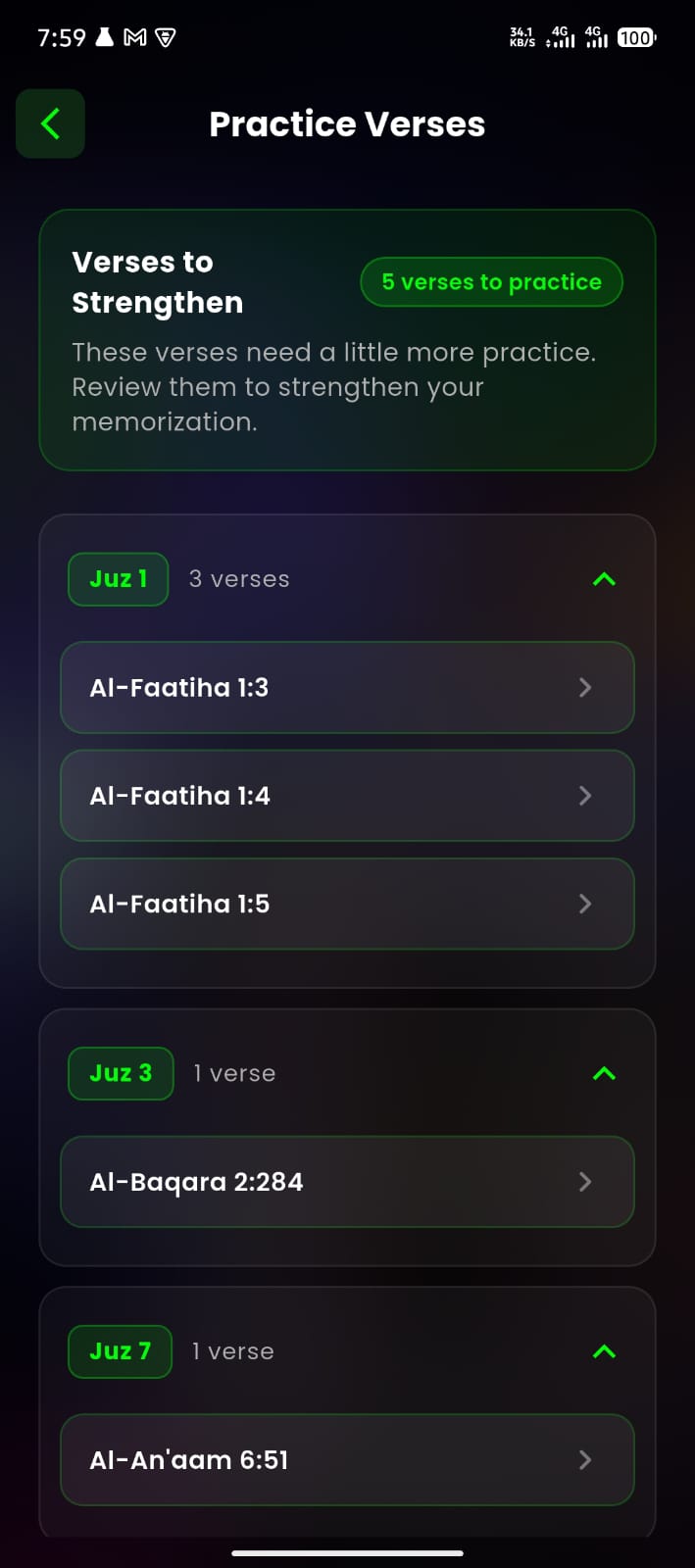
This is the specific gap Hufaaz was built for. You recite out loud, and it catches the exact word you slipped on and plays it back correctly in your chosen Qari's voice — like a teacher sitting beside you. It also schedules your revision, so pages resurface before they fade rather than after.
7. Skipping days and then trying to catch up
You miss three days. Feeling behind, you attempt a triple session to make up ground. It goes badly, you feel worse, and you miss the next four days.
How to fix it: Never try to catch up on hifz. After a gap, do review only for a few days until your recent pages are stable again, then resume new material at your normal pace. And decide in advance what your minimum day looks like — ten minutes of review, no new lesson — so a hard day produces a small session rather than no session.
8. Memorizing without any sense of meaning
Memorizing sounds you don't understand at all is possible, but it's harder and it fades faster. Meaning gives your memory something to hold onto — context, sequence, a reason the verses are in this order.
How to fix it: You don't need to learn Arabic first. Read a translation of the passage before memorizing it. Know what the surah is broadly about. Even this shallow level of understanding measurably improves retention and makes the whole process feel less mechanical.
9. Letting guilt run the process
This one is less discussed and does enormous damage. A student misses a week, feels ashamed, avoids the mushaf because opening it triggers the guilt, and the avoidance compounds. Months pass.
How to fix it: Treat a gap as information, not a verdict — usually it means your plan was too ambitious. Resume with a smaller session, today, without any attempt at making amends for lost time. The only thing that matters is what you do next. Allah says: "Allah does not burden a soul beyond what it can bear." (Qur'an 2:286)
10. Comparing yourself to other people
Someone in your class finishes a juz a month. You take three. You conclude you're not cut out for this.
Memorization speed varies enormously between people and says nothing about sincerity, reward, or eventual outcome. Plenty of slow starters have completed the Qur'an; plenty of fast starters burned out in the first year.
How to fix it: Compare yourself to your own last month. That's the only comparison that carries useful information.
A quick diagnostic
If you're stuck, the specific symptom usually points to the mistake:
| Symptom | Likely cause |
|---|---|
| Old pages disappearing | Too little review (#1) |
| Confident reading, blank in salah | Reviewing by reading (#2) |
| Corrected on the same words repeatedly | Pronunciation set wrong early (#3) |
| Strong for weeks, then collapse | Pace too fast (#4) |
| Jumping between surahs mid-recitation | Similar verses (#5) |
| Fluent but subtly wrong | No external correction (#6) |
| Long gaps, hard restarts | No minimum day / guilt cycle (#7, #9) |
Frequently asked questions
I keep forgetting everything. Should I start over? Almost never. Go back to review-only for a few weeks and rebuild what's shaky. Starting over usually means repeating the same mistake with the same result.
How do I know if I'm memorizing too fast? If your review backlog grows week over week, or you can't recite last month's pages cleanly, you're moving faster than you can consolidate. Slow the new material until review catches up.
Is it bad to memorize from a phone or app rather than a physical mushaf? It's fine, with one caveat: many people memorize partly by page position, so keep the same layout throughout — ideally a standard Uthmani mushaf layout, whether on paper or screen. Switching layouts mid-way is disruptive.
What if my tajweed is weak but I want to start now? Start, but pair it with tajweed work and don't memorize anything you haven't heard recited correctly. Memorizing errors is the one mistake here that's genuinely expensive to undo.
How long does it take to fix a wrongly memorized verse? Longer than learning it right, but it's very doable: isolate it, listen to the correct recitation many times, and recite it correctly in deliberate repetition for several consecutive days. The old version fades with disuse.
Should I memorize alone or with a teacher? A teacher is genuinely better, mainly for correction and accountability. If one isn't available, the two things you must replace are external correction and a review schedule — those are what a teacher actually provides day to day.
I've plateaued for months. Is that normal? Yes. Plateaus are standard, especially once maintaining your existing hifz starts consuming most of your session. Holding what you have during a plateau is not failure — it's the job.
Nearly every hifz problem traces back to the same few causes: too little review, reviewing the wrong way, unfixed mistakes, an unsustainable pace, and guilt after a gap.
None of these require talent to fix. They require a smaller daily plan, honest recitation from memory, and something that tells you where you're actually going wrong.
If you'd like that last part handled — an app that listens, catches the exact word you slip on, and schedules what to revise each day — Hufaaz is free on Google Play.