

Can You Memorize the Qur'an by Listening?
Where audio genuinely helps your hifz, where it quietly fails you, and how to combine listening with reading so the pages actually hold.
It's a fair question, and a lot of people quietly hope the answer is yes. Put a Qari on repeat, listen enough times, and the page goes in by itself.
The honest answer is partly. Listening does help, more than most people think. But on its own it gives you something that feels like memorization and isn't. Knowing where that line falls will save you months.
What listening genuinely does well
Three things, and each one matters.
It fixes your pronunciation before you memorize. This is the strongest argument for audio, and it applies to everyone. If you learn a word wrong and repeat it fifty times, that error is set — and for a non-Arabic speaker especially, a wrong vowel sounds perfectly fine from the inside. Hearing a qualified Qari recite the page first prevents a whole category of mistakes that are painful to remove later.
It teaches rhythm and pausing. The Qur'an has a natural flow, and where you stop matters. Audio carries that in a way the written page can't fully convey, particularly for madd lengths and waqf positions. Our tajweed guide for beginners covers the rules behind what you're hearing.
It uses time that would otherwise be empty. Commutes, chores, walking. This is genuine review time that costs you nothing.
Where listening quietly fails
Here's the part that catches people, and it's worth being precise about.
Listening teaches you to recognise the words. Hifz needs you to produce them. Those are two different skills, and only the second one is memorization.
You can listen to a page two hundred times and know every word the moment you hear it. Then you close the mushaf, and nothing comes out. You can't see that gap while the audio is playing, because the recording is doing the remembering for you. It feels like you know the page. You don't, yet.
It's the same trap as reading a page over and over instead of reciting it from memory. It's one of the most common mistakes in hifz. The test is simple: turn the audio off, close the mushaf, and recite. Whatever comes out is what you actually have.
Why reciting aloud does what listening can't
Part of hifz lives in your tongue, not just your mind. Your mouth learns the order of the words too. That's why a hafiz who goes blank can often get going again just by starting to speak.
Listening never builds that layer. Only producing the words does.
There's also the question of mistakes. When you recite aloud, you hear your own. When you just listen, the Qari is right every time — so nothing tells you where your weak spots are.
The role Allah gave to recitation
It's worth noting that the tradition itself is built around recitation, not passive listening. The Prophet ﷺ said:
"The one who is proficient in the recitation of the Qur'an will be with the honourable and obedient scribes, and he who recites the Qur'an and finds it difficult to recite, doing his best to recite it in the best way possible, will have a double reward." — Sahih al-Bukhari 4937; Sahih Muslim 798
The reward here is tied to the effort of reciting, including the struggle. So that hard feeling when you pull a page out of memory isn't a sign you're doing it wrong. That is the work.
Listening to the Qur'an carries its own reward and Allah commands it directly:
"So when the Qur'an is recited, then listen to it and pay attention that you may receive mercy." — Surah Al-A'raf 7:204
Both have their place. The point here is smaller: when it comes to memorizing, listening gets you ready and keeps things fresh — but reciting is what stores the page.
How to actually use audio in your routine
This is the practical part. Use listening at three specific points.
Before memorizing — listen to the page two or three times while following along in the mushaf. You're not trying to retain anything yet. You're removing pronunciation surprises and letting the rhythm settle.
While memorizing — listen line by line, then say it yourself. Play the line, pause, recite it from memory. That pause matters. Without it you're only following along, which takes you back to recognising instead of remembering.
After memorizing — use audio for review in dead time. Commutes, walking, chores. And here's the technique that makes this genuinely useful rather than passive: recite along from memory and let the audio catch you. When you falter and the Qari continues without you, you've just found a weak spot. Note it and work it properly later.
That one habit turns listening from something you sit through into something you do. That's the whole difference.
Choosing what to listen to
Two things matter more than personal preference.
Pick one Qari and stay with them through a portion. Different reciters pause in different places and vary the pace. Switching between them mid-memorization gives your memory inconsistent anchors.
Choose a measured pace over a fast one. Murattal (slow, clear recitation) serves memorization far better than a rapid reading. You need to hear each word distinctly enough to reproduce it.
Beyond that, choose a Qari you find easy to listen to. You'll be hearing them a great deal.
Who benefits most from audio
Children and pre-readers. Before a child can decode the script, listening is genuinely their primary route in, and young children absorb sound patterns remarkably well. How parents can help covers this in more detail.
Non-Arabic speakers. With no instinct for how a word should sound, audio is your correction mechanism. Memorizing without knowing Arabic goes through what else compensates.
Anyone without regular access to a teacher. A recording won't correct you — that's its limitation — but it gives you something accurate to compare yourself against.
Frequently asked questions
Can you memorize the Qur'an just by listening? Not reliably. Listening builds recognition — you'll know the words when you hear them — but hifz requires recall, which is producing the text yourself with nothing in front of you. Those are different abilities, and only reciting from memory develops the second.
Does listening to the Qur'an help memorization? Yes, significantly, in a supporting role. It fixes your pronunciation before errors set, teaches rhythm and pause positions, and makes commutes and chores usable for review. It gets you ready and keeps pages fresh, but it doesn't replace the work of reciting.
Should I listen to the Qur'an before or after memorizing? Both. Listen two or three times before you memorize, following along in the mushaf, to remove pronunciation surprises. Then use audio afterwards for review — reciting along from memory so the recording catches you where you falter.
How many times should I listen to an ayah? There's no fixed number, because listening isn't what stores the verse. Listen enough to be certain of the pronunciation and rhythm — usually two or three focused passes — then switch to reciting it from memory, which is where the actual memorization happens.
Which Qari is best for memorization? Whichever measured, clear reciter you find easy to listen to. Murattal pace matters more than the specific reciter, since you need each word distinct enough to reproduce. Stay with one Qari through a portion, because different reciters pause in different places.
Can children memorize the Qur'an by listening? Young children rely on listening more than adults do, since they absorb sound patterns well before they can read the script. It's genuinely their main route in early on. But as soon as they can read, reciting from memory needs to become the core of their routine.
Is listening to the Qur'an rewarded even if I'm not memorizing? Yes. Allah says, "So when the Qur'an is recited, then listen to it and pay attention that you may receive mercy" (Surah Al-A'raf 7:204). Listening attentively is an act of worship in its own right, separate from any memorization goal.
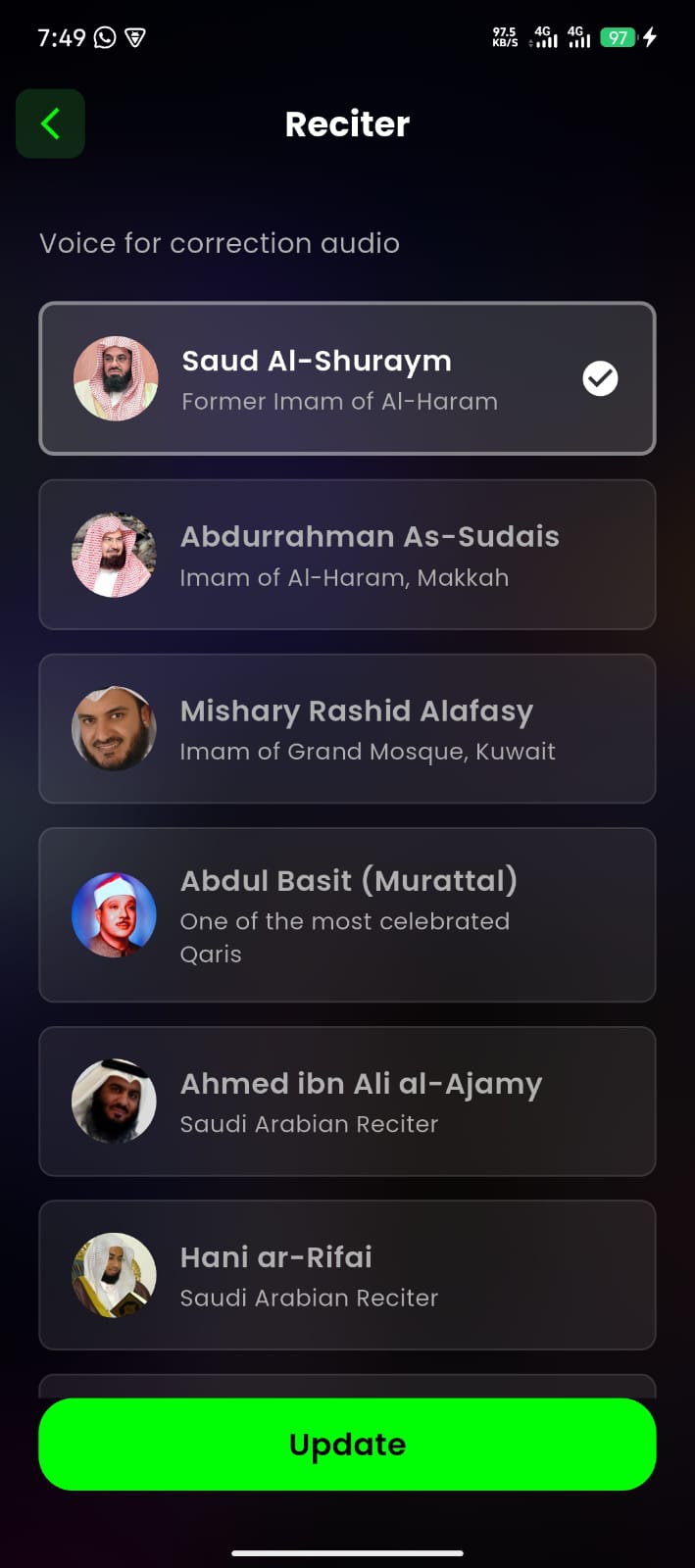
You can't see the gap between knowing a page when you hear it and being able to recite it — not until you close the mushaf, which is exactly when most people find out. Hufaaz listens while you recite from memory, catches the precise word you slip on, and plays the correct version in your chosen Qari's voice.
Conclusion
Listening is a genuine tool in hifz, and people who skip it memorize errors they could have avoided. But it prepares and reinforces; it does not store.
Listen before you memorize to get the pronunciation right. Listen line by line while memorizing, pausing to produce each line yourself. Listen afterwards during dead time, reciting along so the audio catches your weak spots.
Then close the mushaf, turn the audio off, and recite. That's the only measure of what you actually hold.
If you'd like something that listens back while you recite, Hufaaz is free on Google Play. May Allah make your tongue firm upon His words.