

Completed Your Hifz? How to Never Forget It
Finishing hifz is the beginning, not the end. How to protect your memorization for life: a review cycle, guarding against forgetting, and staying firm.
Completing the memorization of the entire Qur'an is one of the greatest achievements in a believer's life. If Allah has granted you this, it is an immense blessing — and the natural feeling is relief: the hard part is done.
But every experienced hafiz will tell you a sobering truth: finishing hifz is the beginning, not the end. The Qur'an is easily lost without care, and many who complete their memorization watch it slip away in the years that follow — not through any failing of character, but simply through neglecting review. This article is about how to make sure that never happens to you.
Why this matters
The Prophet ﷺ warned us directly about how easily the Qur'an leaves the one who doesn't tend to it. He said: "Keep on reciting the Qur'an, for by Him in Whose Hand my soul is, it escapes from memory faster than a camel escapes from its tying rope." (Bukhari and Muslim)
The image is precise. A camel left untied wanders off; the Qur'an left un-reviewed wanders out of the heart — and quickly. Protecting your hifz is not optional maintenance. It is a continuation of the responsibility you took on when you began, and it carries its own great reward.
The mindset shift after completion
During memorization, most of your energy went into new pages. After completion, that flips entirely: your job is now protection, not acquisition. The whole Qur'an is your responsibility to keep firm.
This is actually good news. You no longer have to memorize anything new — you simply have to keep visiting what you already hold. But it requires a real, ongoing commitment. The hifz that took years to build can erode in months of neglect, and can take even longer to rebuild than it took to memorize the first time.
Build a review cycle (the core of maintenance)
The single most important thing after completion is a fixed review cycle — a rotation that takes you through the entire Qur'an on a regular schedule, so no portion goes untouched for too long. Choose the pace that fits your life:
- One juz per day completes the whole Qur'an every 30 days — a manageable rhythm for students and working adults alike.
- Two juz per day completes a full cycle every 15 days — stronger retention for those with more time or a fresher completion.
- Half a juz per day still cycles the entire Qur'an in about two months — a realistic minimum for the busiest schedules.
The exact number matters less than the principle: every page must come back around on a schedule. A hafiz who recites a juz a day, from memory, will keep the Qur'an firm for life. (Our revision schedule guide covers structuring this in detail.)
Practical habits that protect your hifz
Recite in your prayers
One of the most beautiful and effective methods: recite different portions of the Qur'an in your daily salah — especially the voluntary and night prayers. This weaves review into worship you're already performing, and standing with the verses in prayer fixes them deeply.
Recite from memory, not from the mushaf
Reading from the page during review keeps your recitation fresh but lets your memory weaken — because the memory isn't being made to produce the words. For maintenance, recite from memory, and only check the mushaf when you're unsure. Recitation from memory is the muscle you're keeping strong.
Guard the mutashabihat
The similar verses remain the most common cause of error long after completion — arguably more so, because you now hold hundreds of similar pairs in memory. Keep giving them deliberate attention. (See what are the mutashabihat.)
Find a review partner or reciting circle
Reciting to someone — a partner, a teacher, a halaqah — catches the errors you've stopped noticing in yourself, and adds accountability that keeps the cycle from slipping. Many huffaz maintain lifelong reciting partnerships for exactly this reason.
Aim for itqan (mastery), not just retention
There's a difference between "I roughly still have it" and true itqan — precise, confident, error-free recall. After completion, work gradually toward mastery of each juz: not just remembering the page, but reciting it with certainty, correct tajweed, and no hesitation. This is the standard worth pursuing.
Never let a day pass with nothing
Even on your busiest day, recite something from memory. The habit of daily contact is what keeps the rope tied. A completely empty day makes the next empty day easier — and that's how hifz quietly erodes.
Common mistakes after completing hifz
- Treating completion as the finish line. It is the start of lifelong maintenance.
- Stopping or loosening review after the celebration. The most common way hifz is lost.
- Reviewing only from the mushaf. It keeps recitation fresh but lets memory fade — recite from memory.
- Neglecting the mutashabihat. They cause more post-completion errors than anything else.
- Reviewing with no schedule. "When I get time" becomes never. A fixed cycle is essential.
- Reviewing alone forever with no correction. Errors you can't hear in yourself become permanent.
- Settling for rough retention instead of itqan. Aim for mastery, not just "I mostly still have it."
Frequently asked questions
How do I keep from forgetting the Qur'an after completing hifz? Build a fixed review cycle that takes you through the entire Qur'an on a schedule — commonly one juz a day for a monthly cycle — and recite from memory rather than the mushaf. Consistent, scheduled review is the whole answer.
How much should I review each day after finishing hifz? A common and effective standard is one juz per day, cycling the whole Qur'an every 30 days. If time is tight, even half a juz a day cycles it in about two months. Choose a sustainable pace and never break it.
Why is it so easy to forget the Qur'an? The Prophet ﷺ compared it to a camel that escapes faster than one from its rope — memory naturally fades without revisiting. The Qur'an requires continuous review to stay firm; neglect is what causes loss, not weak ability.
Should I review from memory or from the mushaf? Primarily from memory, checking the mushaf only when unsure. Reading from the page keeps recitation fluent but lets the memory weaken, because recall isn't being exercised. Reciting from memory is what maintains hifz.
What is itqan and why does it matter? Itqan is precise, confident, error-free mastery of the Qur'an — not merely rough retention. After completion, work gradually toward reciting each juz with certainty and correct tajweed. It's the standard that makes your hifz truly firm and beneficial.
Can I recover hifz I've already started to forget? Yes. Revive it by returning to a structured cycle and giving weaker portions extra attention until they're firm again. It's harder than maintaining, which is exactly why prevention through consistent review is so important.
Does reciting in prayer really help maintain hifz? Very much. Reciting varied portions in your daily and night prayers weaves review into worship you already perform, and standing with the verses in salah fixes them deeply. It's one of the most effective and blessed maintenance habits.
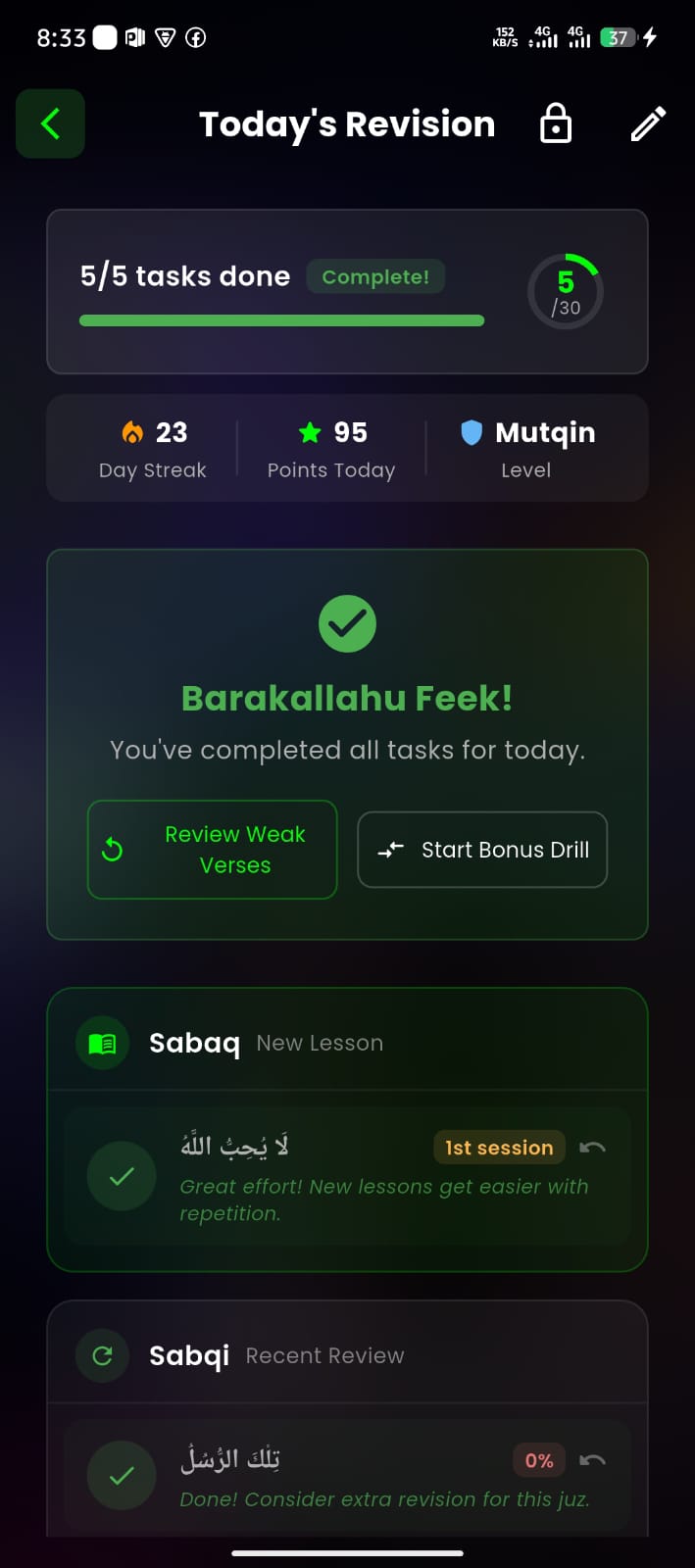
Maintaining the whole Qur'an is a scheduling problem as much as a memory one — knowing which juz is due, which pages are weak, and catching the errors you can no longer hear in yourself. Hufaaz handles exactly that: it runs your review cycle for you, resurfaces weak pages sooner, and — as you recite from memory — catches the precise word you slip on and corrects it in your chosen Qari's voice. It's built to keep your hifz firm for life.
Conclusion
You've been given something extraordinary — the entire Qur'an, carried in your heart. Now the work becomes keeping it there. Tie the rope daily: build a fixed review cycle, recite from memory, weave the Qur'an into your prayers, guard the similar verses, seek out correction, and aim for true mastery. Do this, and by Allah's permission the Qur'an will stay with you for the rest of your life — a companion, an honour, and an intercessor on the Day you meet Him.
If you'd like a companion to run your review cycle and keep every juz firm, Hufaaz is free on Google Play. May Allah make you of the people of the Qur'an, and keep it firm in your heart until you meet Him.