

How to Memorize Qur'an as a Student
Exams, deadlines and a timetable that changes every term. A hifz plan built for student life — including what to do during exam season instead of quitting.
Student life is an odd mix for hifz. Your memory is at its sharpest, you have fewer real responsibilities than you ever will again — and your schedule is chaos. Different timetable every term, deadlines that arrive in clusters, and three weeks of exams that flatten everything else.
So the problem isn't ability. It's that a plan built in September doesn't survive December. What a student needs isn't a better routine — it's one that bends without breaking.
Here's how to build that.
Your advantage is real, so use it
Start with the good news, because it's easy to miss when you're stressed.
Memory for new material is genuinely at its strongest in your teens and twenties. The same page that takes you twenty-five minutes now will take noticeably longer at forty, between a job and children. Adults who start hifz late almost all say the same thing — they wish they'd begun when they were where you are.
You also have something you won't have later: large blocks of unstructured time. They don't feel large because they're scattered between lectures and filled with other things. But compared to a working adult's day, they're enormous.
Anchor to the timetable, not the clock
Here's the mistake most students make. They pick a time — "I'll memorize at 7pm" — and it works until the timetable changes, then it quietly stops.
Anchor to events instead. Not 7pm, but after Fajr, before I leave. Not 4pm, but the first thirty minutes after I get back. Events survive a new term; clock times don't.
For most students the strongest anchors are:
- After Fajr, before the day starts
- The gap between getting home and dinner
- After Isha, before the evening's work
Pick one for new memorization and protect it. Our guide on the best time of day for hifz helps you choose between them.
Fill the gaps with review, not new pages
New memorization needs quiet and a clear head. Review doesn't — and that difference is what makes a student schedule work.
Student days are full of dead time that's useless for anything demanding but perfect for review:
- The commute or walk to campus
- The gap between two lectures
- Queues, waiting rooms, the bus
- Walking between buildings
None of these will hold new memorization. All of them hold review comfortably. Most students find thirty minutes a day here that costs them nothing they were otherwise using.
And recite your recent pages in your daily prayers. It's free repetition inside worship you're already performing, and over a term it adds up to a lot.
Exam season: the part that decides everything
This is where student hifz usually dies, so plan it before it arrives.
The instinct during exams is to stop completely — pause hifz for three weeks, resume after. It sounds sensible and it's the single most damaging thing you can do, for two reasons. Your memorized pages go soft during the gap, and the habit breaks. Restarting a stopped routine is far harder than maintaining a small one.
So don't stop. Shrink instead.
Drop new memorization to zero. Give up the new pages for those weeks without guilt. That's the right call.
Keep review non-negotiable, at fifteen minutes. Just enough to keep the cycle alive and your pages from softening. Fifteen minutes does not meaningfully affect your exam results, and it's the difference between resuming and restarting.
Return to normal the day after your last exam. Not next week. The gap after exams is what actually breaks people — the routine survives the exams and then dies in the celebration.
Don't let hifz and studies compete
A worry worth naming, because it stops a lot of students before they start: will this hurt my degree?
Handled properly, no. Fifteen to thirty minutes of memorization and some review in gaps is not what determines exam results. Students with far larger commitments — sports, jobs, societies — graduate fine every year.
What does hurt is trying to run a full-time hifz pace alongside full-time study. Two pages a day during term will cost you either your grades or your hifz, and usually both. This is the common mistake of setting a pace that can't hold.
Pick the pace for your worst week — exam week, deadline week — and hold it steadily. Three to five lines a day, six days a week, still finishes several juz across a degree.
A shape that works during term
To make it concrete:
After Fajr (20–25 min) — new portion, three to five lines. This is your protected slot.
Commute / between lectures (15 min) — review recent pages.
In your prayers — recite what you've recently memorized. No extra time.
Before sleep (10 min) — recite today's portion once. It settles overnight.
That's roughly fifty minutes, of which only twenty-five needed protecting. The rest sits inside time you were already spending.
Find someone to recite to
This one's easier at university than it will ever be again, and it matters more than most students realise.
Errors you can't hear are the ones that get memorized. You need someone following in the mushaf who'll stop you — a campus Islamic society, a local masjid, a friend further along than you, or a teacher over a weekly call.
Even one session a week is enough to catch things before they set. Without it, you can memorize a whole juz with a mistake in it and never know.
Frequently asked questions
Can I memorize the Qur'an while studying full-time? Yes, and student years are one of the better times to do it — memory for new material is at its strongest and your schedule has more gaps than a working adult's. The key is a small, steady portion of three to five lines a day rather than a full-time hifz pace alongside full-time study.
How do I memorize Qur'an during exams? Don't stop — shrink. Drop new memorization to zero for those weeks and keep review at a non-negotiable fifteen minutes a day. Stopping completely lets your pages go soft and breaks the habit, and restarting is much harder than maintaining a small routine.
Will hifz affect my grades? Twenty to thirty minutes a day won't. What does cause problems is attempting a full-time hifz pace during term, which usually costs you both your grades and your hifz. Set the pace for your busiest week, not your freest one.
When should a student memorize Qur'an? Anchor the session to a fixed event rather than a clock time, since timetables change every term. After Fajr before the day starts, the first half hour after getting home, or after Isha all work well. Events survive a new timetable; "7pm" doesn't.
How can I revise Qur'an between lectures? Review survives noise and interruption far better than new memorization does, so it fits commutes, gaps between lectures, queues and walks across campus. Reciting recent pages inside your daily prayers adds more repetition without costing extra time.
How much should a student memorize each day? Three to five lines a day, six days a week, is a realistic term-time target and still completes several juz across a degree. If you can't recite yesterday's portion cleanly the next morning, the amount is too large.
Is it better to wait until after graduation to start hifz? Usually not. Memory for new material is stronger now than it will be later, and post-graduation life tends to bring a job and family rather than free time. Starting small during study beats waiting for a clear schedule that rarely arrives.
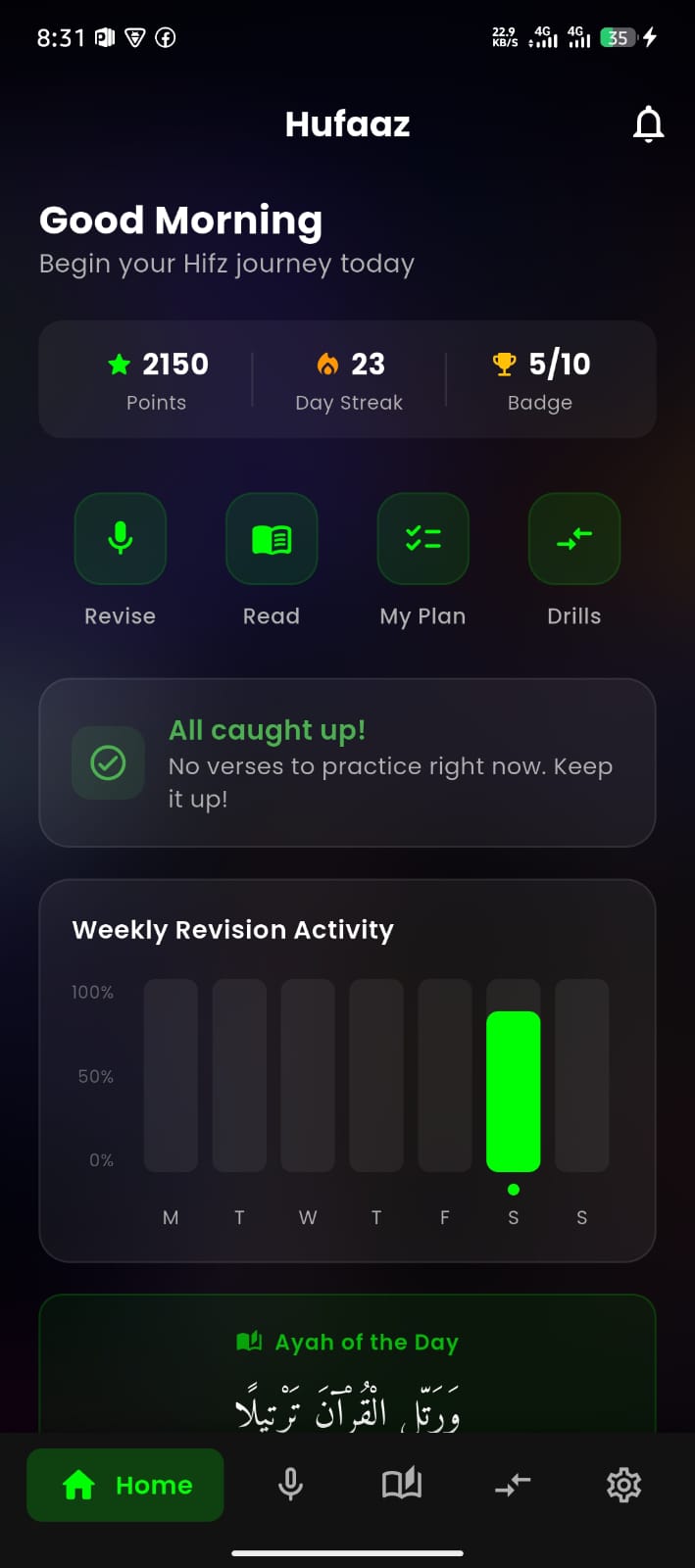
The risk in a student schedule is review quietly falling behind during a heavy week and nobody noticing until a juz has gone soft. Hufaaz runs that cycle for you, surfaces the pages that are slipping first, and as you recite from memory it catches the exact word you stumble on and corrects it in your chosen Qari's voice.
Conclusion
Student hifz isn't a compromised version of the real thing. It's the same work, arranged around a timetable that keeps moving.
Anchor your session to an event rather than an hour. Keep new memorization small and protected. Push review into the gaps you already have. And when exams arrive, shrink to fifteen minutes instead of stopping — then resume the day after the last paper.
Do that across a degree and you'll finish with several juz held firmly, at the time in your life when memorizing was easiest.
If you'd like something to track what's due while the term does its worst, Hufaaz is free on Google Play. May Allah make both your studies and your hifz easy.