

How to Memorize Qur'an With a Full-Time Job
You have an hour a day, not six. Here's a realistic hifz plan for working adults — how much to attempt, where the minutes actually come from, and what to cut.
Most hifz advice quietly assumes you're a full-time student. Memorize a page a day, review three juz, recite to your teacher twice — a schedule built for someone whose entire day belongs to the Qur'an.
You have an hour, maybe less, and it's the hour when you're most tired. So the honest question isn't how to memorize like a madrasah student. It's this: what does hifz look like when it has to fit around a job — and is it still worth doing?
It is. Working adults complete the Qur'an every year. But they do it with a different plan, and the differences matter more than the effort you put in.
Start by fixing the number in your head
The single biggest cause of failure here isn't lack of time. It's aiming at a full-time pace with part-time hours, missing it for two weeks, and concluding you can't do this.
So set the number honestly. At five lines a day, with a realistic six days a week, you finish the Qur'an in roughly six to seven years. At a quarter page a day, closer to eight. Those numbers look long written down. But six years of steady progress ends with the whole Qur'an memorized, and two years of ambitious plans that keep collapsing ends with nothing.
Pick the pace you can hold on a bad week, not a good one. You can always add later; you cannot recover the months lost to restarting.
Where the minutes actually come from
An hour a day rarely exists as one clean block. It exists as fragments, and the working adult's real skill is finding them.
New memorization needs one protected slot. This is the only part that genuinely requires quiet and a clear head. Twenty to thirty minutes, same time daily. For most people that's after Fajr or immediately after Isha — whichever leaves you more alert. (Our guide on the best time of day for hifz helps you choose between them.)
Review can live in the gaps. This is the part people miss. Once a page is memorized, revisiting it is much closer to a physical skill than mental work — it survives noise, tiredness and interruption. Which means it fits places new memorization never could:
- The commute, in both directions
- The walk between the car and the office
- Waiting for meetings to start, or for the kettle
- Cooking, washing up, folding laundry
- The ten minutes in bed before sleep
None of these are impressive on their own. Together they're often thirty to forty minutes of review a day that costs you no extra time at all.
Salah is free repetition. Reciting your recent pages in your daily prayers gives them reps you would otherwise have to schedule. Working adults who use this consistently get a meaningful chunk of their review done inside worship they're already performing.
The one non-negotiable: protect the review
Here is the trap that catches almost every working memorizer.
New pages feel like progress. Review feels like standing still. So on a busy day, the instinct is to keep memorizing and let review slide — just today, just this week.
That is the exact mechanism by which people lose years of work. Review debt compounds silently. You don't notice for a month, and then you discover that thirty pages you "know" have quietly gone soft, and clawing them back costs far more than the review you skipped.
So invert the priority. On a day when you can only do one thing, do the review and skip the new page. A day without new memorization costs you one page of progress. A month of skipped review can cost you a juz.
If your review load has grown past what your day can hold, that's not a discipline problem — it's a signal to slow your new memorization until the balance is sustainable. This is what the revision schedule guide is for.
What to cut
A working adult's hifz plan needs to be smaller than a student's, and choosing what to drop is part of the job.
Cut the pace, not the review. Half a page memorized properly and reviewed on schedule beats two pages memorized and abandoned.
Cut the perfect conditions. Waiting for a quiet house, a free evening, or a settled work period means waiting indefinitely. Memorize in the conditions you have.
Cut the comparison. You are not behind a full-time student. You're running a different race with different constraints, and the finish line is identical.
Don't cut the correction. This is the one thing that looks optional and isn't. Reciting to someone who catches your errors is what keeps you from memorizing mistakes — and the errors that survive are precisely the ones you recite confidently and cannot hear. If a weekly session with a teacher is all you can manage, that's still far better than none.
A realistic weekday
To make it concrete, here's a shape that works for many working adults:
After Fajr (25 min) — new portion. Five lines, worked until solid. This is the protected slot; nothing else goes here.
Commute in (15 min) — review yesterday's portion and the day before's.
Through the day — recite recent pages in the fard prayers. No extra time needed.
Commute home (15 min) — older review, working through your cycle.
Before sleep (10 min) — re-recite today's new portion once. It settles overnight.
That's about sixty-five minutes, of which only twenty-five needed protecting. The rest occupied time that was already being spent.
On the years
The timeline is the part that discourages people most, so it's worth addressing directly.
Six or seven years sounds like a long time. But consider what the alternative usually is: not a faster completion, but no completion at all — a few enthusiastic months, a collapse, a gap, another attempt from the beginning.
And the years aren't empty. Two years in, you have several juz memorized and reviewed. That is not a down payment on a future reward; it is already the thing itself. Every page you hold, you hold now.
The Prophet ﷺ told us the one who struggles with the Qur'an and finds it hard has two rewards. Your circumstances make this harder, and that difficulty is counted, not deducted.
Frequently asked questions
Can I memorize the Qur'an while working full-time? Yes. Working adults complete the Qur'an every year, but with a different plan: a smaller daily portion, review spread through commutes and gaps, and recitation of recent pages inside the daily prayers. The pace is slower; the destination is the same.
How much Qur'an can I memorize with a full-time job? Five lines a day, six days a week, completes the Qur'an in roughly six to seven years. A quarter page daily lands closer to eight. Choose the amount you can hold on a bad week — a modest pace kept for years beats an ambitious one that collapses in months.
When should I memorize if I work all day? Reserve one protected slot of twenty to thirty minutes for new memorization, usually after Fajr or after Isha, whichever leaves you more alert. Review doesn't need that protection and can fill commutes, waiting time, and the minutes before sleep.
What if I can only do one thing on a busy day — review or new memorization? Review, without hesitation. Skipping a new page costs you one page of progress. Skipping review lets memorized pages quietly go soft, and recovering them costs far more than the review you skipped. Review debt compounds silently.
Is it worth starting hifz if it will take me seven years? Yes, because the realistic alternative is usually no completion at all rather than a faster one. And the years aren't a waiting period — two years in you already hold several juz firmly. Every page you've memorized, you have now.
Can I really review Qur'an while commuting or doing chores? Yes, and this is where most of a working adult's review happens. Once a page is memorized, revisiting it behaves more like a physical skill than mental work, so it survives noise and interruption well. New memorization does not — keep that in your protected slot.
Do I still need a teacher if I'm memorizing part-time? Yes. Correction is the one thing that looks optional and isn't, because the errors that survive into your hifz are the ones you recite fluently and cannot hear yourself making. Even a single weekly session is far better than none.
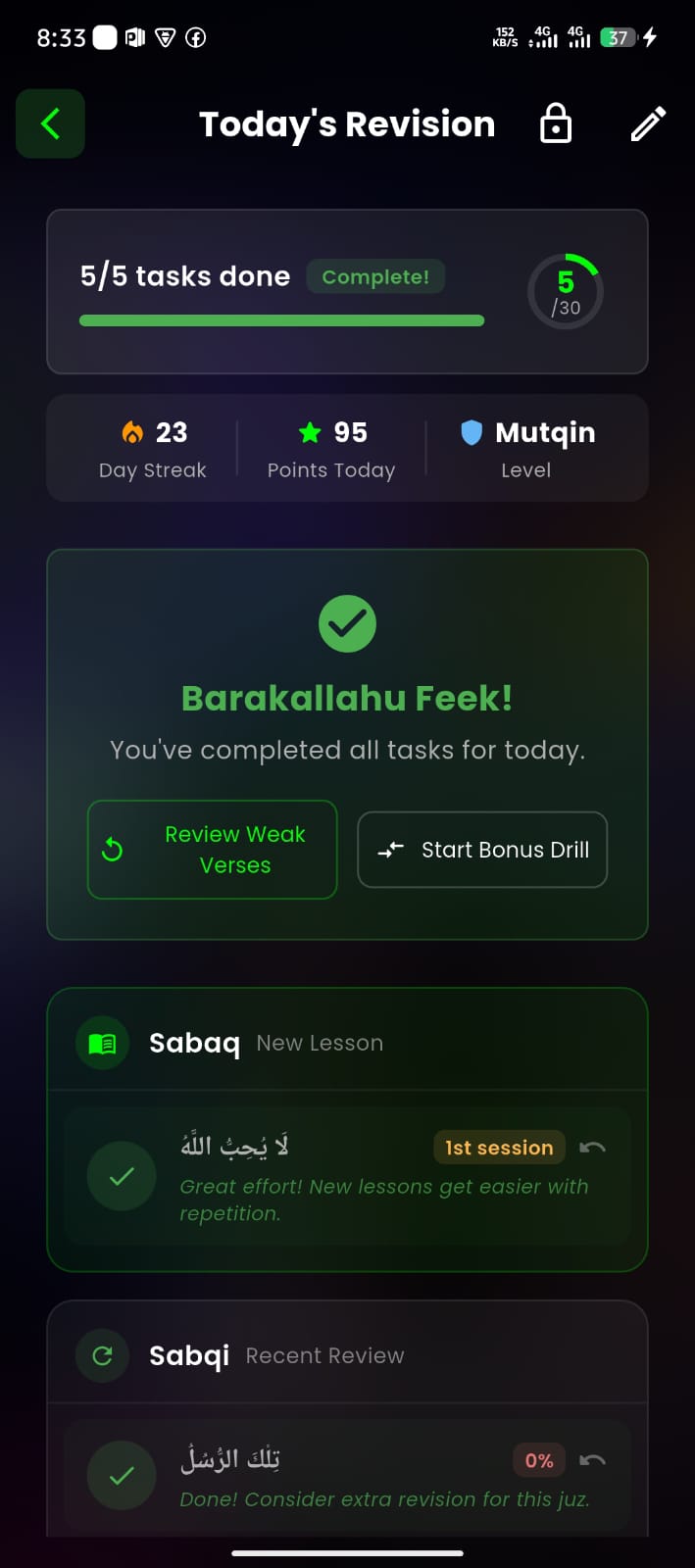
The bookkeeping is what usually breaks a part-time hifz: which pages are due, which have gone soft, and which error you've been repeating without knowing. Hufaaz handles that — it runs the review cycle, surfaces weak pages sooner, and as you recite from memory it catches the exact word you slip on and corrects it in your chosen Qari's voice.
Conclusion
Hifz with a job is not a compromised version of the real thing. It's the same work, arranged differently: a small protected slot for new pages, review scattered through the day's existing gaps, and the review guarded more carefully than the progress.
Set the pace for your worst week. Protect the review above all. Get corrected by someone who can hear what you cannot. Then let the years do what years do.
If you'd like something to track what's due and catch the slips, Hufaaz is free on Google Play. May Allah bless the little time you have and make it enough.