

How to Test If Your Hifz Is Really Solid
Simple ways to check whether a page is truly memorized or only feels that way — and what to do with the weak spots you find.
You finish reciting a juz, it goes smoothly, and you feel good about it. Three months later the same juz falls apart, and you can't work out what changed.
Nothing changed. It was never as strong as it felt — and the way you were checking couldn't show you that.
Reciting a page from the beginning is the easiest possible test. It hides weak spots instead of finding them. Here are better ways to check, and what to do with what you find.
Why reciting from the top is a weak test
When you start at the beginning of a page, each line pulls the next one along. The momentum carries you, and you can pass the whole page without really knowing any single part of it on its own.
That's fine for practice. It's useless as a test, because it can't tell the difference between a page you know and a page you can only ride through.
A real test takes that momentum away.
Five ways to actually test yourself
Each one removes a different crutch. Use whichever fits the time you have.
1. Start from the middle
Open the page, pick a line somewhere in the middle, and recite from there.
This is the simplest honest test, and it's harsh. Without the run-up, you find out whether you know that line or only know what comes before it. If you can start cleanly from any line on the page, the page is genuinely solid.
2. Recite one ayah, then stop
Say a single ayah from memory, then stop and name what comes next before reciting it.
Weak hifz works like a chain — each ayah only arrives because the one before pushed it out. Strong hifz lets you jump in anywhere. If you can't say what follows without reciting your way there, that link is weak.
3. Recite the last line of each page
Go through a juz reciting only the final line of every page, then the first line of the next.
Page joins are where hifz quietly breaks. People know pages well and can't move between them, because they only ever practised each page separately. This test finds those gaps fast.
4. Leave it a week, then recite
Pick a juz you haven't touched for a week and recite it cold, with no warm-up.
This is the closest thing to how you'll actually need it — in taraweeh, in salah, when someone asks. A page that needs ten minutes of warming up isn't ready.
5. Recite to another person
The strongest test, because it removes the crutch you can't remove yourself.
Reciting alone, you skip over small wobbles without noticing, and you can't hear your own pronunciation mistakes. Someone following in the mushaf catches both. Even once a week makes a difference, and how to choose a teacher covers what to look for in whoever does it.
How often to test
Not every day. Testing is for finding problems, and you need time in between to fix them.
A simple rhythm:
- Recent pages — the middle-of-the-page test, once a week
- Older juz — a cold recitation whenever that juz comes round in your review cycle
- Everything — recite to another person weekly, if you can arrange it
If you don't have a review cycle yet, that's the thing to build first. The revision schedule guide sets one out.
Reading the results honestly
Test results only help if you're straight with yourself about them. Three rules.
A hesitation counts as a mistake. If you paused, even briefly, that spot isn't solid. People wave these away because the word did eventually arrive. Under pressure — leading salah, reciting to a teacher — the pause becomes a stop.
A prompt means you didn't have it. If someone gave you the first word and then it flowed, you didn't know that line. You recognised it once it was handed to you, which is a different thing.
Note where, not just how many. "Three mistakes" tells you nothing useful. "Stumbled at the top of page 4, twice" tells you exactly what to work on tomorrow.
What to do with a weak spot
Finding problems is only half of it. Here's what actually fixes them.
Work the specific place, not the whole page. If you stumble at one join, re-reciting the whole page ten times mostly rehearses what's already fine. Open the mushaf at that join, look at the two lines around it, and repeat just that transition ten times.
Check whether it's a similar verse. If you didn't blank but slid into a different passage, that's not weak memory — your memory took a wrong turn between two passages that sound alike. It needs its own method, covered in what the mutashabihat are.
Bring that page back sooner. A page that failed shouldn't wait for its normal turn in the cycle. Pull it forward and test it again in a few days.
If a whole juz fails, slow down. One bad page is normal. A juz coming apart usually means you're memorizing faster than you can hold, and the fix is fewer new pages until the balance is right.
A note on how this feels
Honest testing is uncomfortable. You go in thinking a juz is strong and come out with a list of problems, and it's easy to read that as proof you're bad at this.
It's the opposite. The mistakes were already there — testing just showed them to you while they're still small and easy to fix. The alternative is finding out in taraweeh, or two years later when the whole juz has gone soft.
A page that passes a hard test is worth more than five pages that pass an easy one.
Frequently asked questions
How do I know if I've really memorized a page of the Qur'an? Start reciting from a line in the middle rather than the top. If you can begin cleanly from any point on the page, it's solid. If you can only get through it by starting at the beginning, the momentum was carrying you rather than your memory.
How often should I test my hifz? Test recent pages about once a week, and older juz whenever they come round in your review cycle. Leave enough gap between tests to actually fix what you found — testing daily just finds the same problems before you've had time to work on them.
What counts as a mistake when testing yourself? Any hesitation, and any line that only came after a prompt. People excuse both because the words eventually arrived, but under pressure a pause becomes a stop, and a prompted line means you recognised it rather than recalled it.
Why does my hifz fall apart when I recite to someone? Because reciting alone lets you skip small wobbles without noticing, and you can't hear your own pronunciation errors. Another person following in the mushaf catches both. That's not a sign your hifz is worse than you thought — it's the first accurate measurement of it.
What should I do when I find a weak spot? Work that exact place rather than the whole page. Open the mushaf at the point you stumbled, look at the two lines around it, and repeat just that transition about ten times. Then bring that page back for another test in a few days.
Is it normal to fail a test on a juz I thought was strong? Yes, and it's useful. The weak spots were already there — the test only revealed them while they're small. Finding out now is far better than discovering it in taraweeh or after the whole juz has softened.
Should I test the joins between pages? Yes, and most people skip this. Recite only the last line of each page followed by the first line of the next. Page joins are where hifz commonly breaks, because people practise pages separately and never rehearse moving between them.
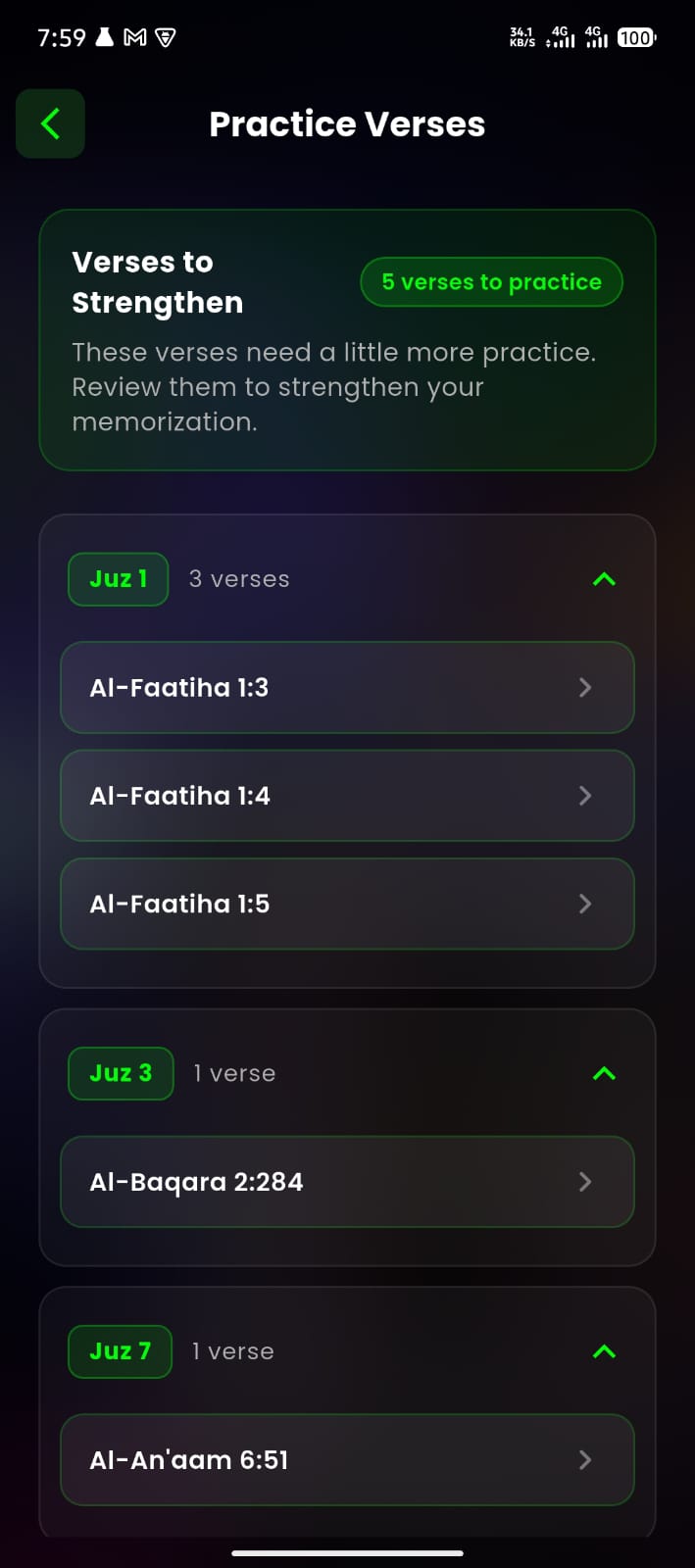
Testing yourself has one blind spot you can't close alone: you cannot hear your own pronunciation mistakes, because they sound correct from the inside. Hufaaz listens as you recite from memory, catches the exact word you get wrong, and plays the correct version in your chosen Qari's voice.
Conclusion
Reciting a page from the top tells you very little. Start from the middle instead, jump in at a single ayah, test the joins between pages, and recite cold after a week away.
Count every hesitation. Note where it happened, not just how many. Then work that exact spot rather than the whole page.
Do that regularly and your hifz stops being something you hope is solid and becomes something you've checked.
If you'd like something to test against while you recite, Hufaaz is free on Google Play. May Allah make your recitation firm when you need it most.