
Can You Memorize the Qur'an Without Knowing Arabic?
Millions of huffaz don't speak Arabic. Here's what that actually costs you in hifz, what it doesn't, and the small amount of Arabic worth learning alongside.
It's a question that stops a lot of people before they begin: the Qur'an is in Arabic, and I don't speak Arabic. Am I even allowed to do this, and will it work?
The short answer is yes on both counts. The majority of huffaz in the world today are not native Arabic speakers. Across the Indian subcontinent, Southeast Asia, Turkey, and much of Africa, hifz has been completed by non-Arabs for centuries, in enormous numbers. This is not an exception to the tradition; it is most of the tradition.
But the honest answer has more in it than that. Not knowing Arabic makes hifz harder in a few specific ways — and being clear about which ones lets you deal with them instead of being surprised by them.
What you genuinely lose
There's no point pretending. The difference is real.
Meaning gives memory something to hold. When you understand a sentence, you remember its shape, not just its sounds. If you lose a word, the sense of the passage tells you roughly what belongs there. Without that, you're holding a longer chain of sounds with fewer handles on it.
Grammar predicts endings. An Arabic speaker feels when a word should carry one ending rather than another. That intuition quietly prevents a whole category of error. Without it, every ending is something to be memorized rather than something you'd notice was wrong.
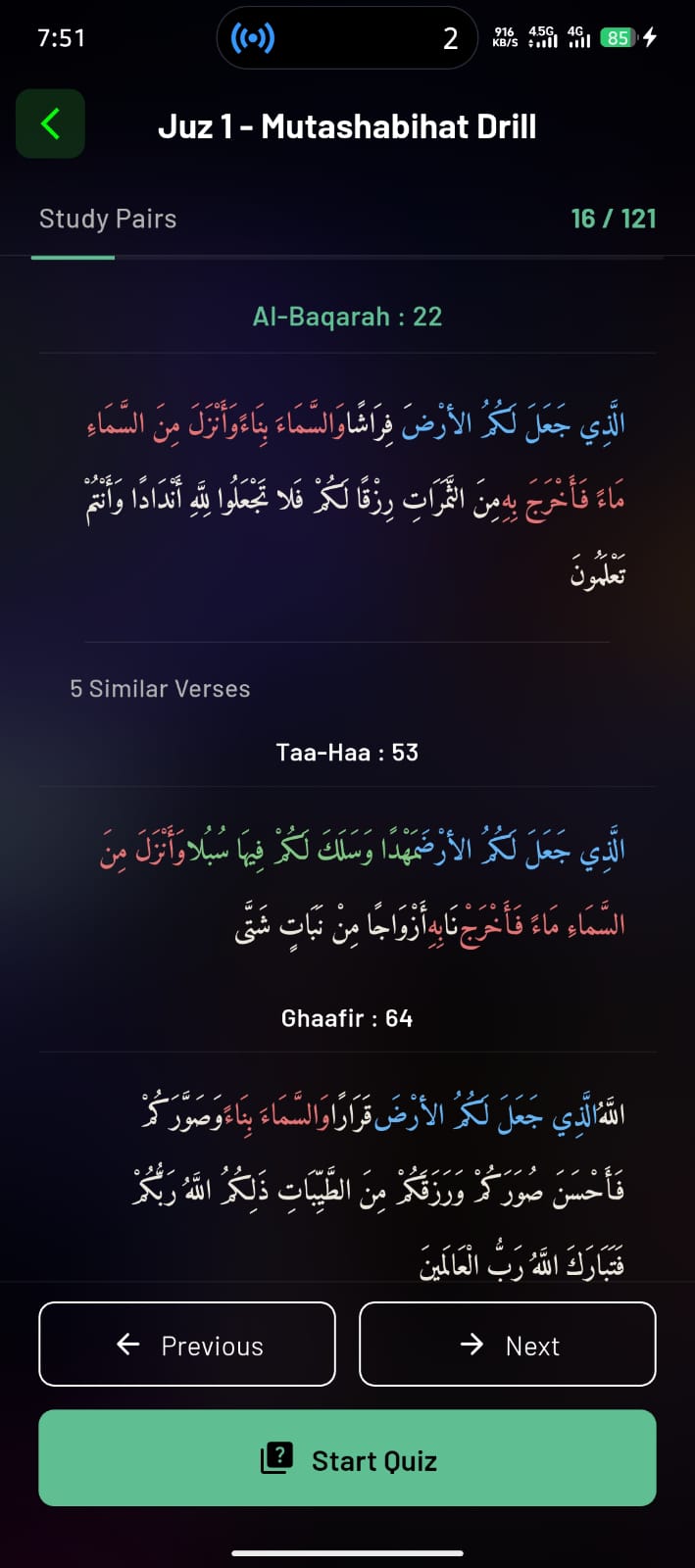
Similar passages are harder to separate. The mutashabihat — verses that closely resemble one another — are the hardest part of hifz for everyone. But someone who follows the meaning has an extra signal for telling them apart: the two passages say slightly different things in slightly different contexts. Without that, the only difference is the sound, which is precisely what's similar.
So it is harder. That's the truthful version, and worth knowing in advance — so you don't mistake normal difficulty for personal failure.
What you do not lose
Now the other side. It matters just as much.
The reward is not reduced. Hifz is an act of preserving the Qur'an, and that preservation is exactly what non-Arab huffaz have been doing for over a thousand years. Nothing in the reward is conditioned on your first language.
Memorization itself doesn't require comprehension. Human memory stores sequences perfectly well without semantic content — that's why children memorize whole surahs long before they understand a word of them. Meaning is a helpful aid, not a mechanism you're missing.
The sound structure helps you anyway. The Qur'an has rhythm, rhyme and repeated phrase patterns throughout. These are strong memory anchors and they work regardless of whether you follow the meaning. You'll start noticing them within weeks, and they carry more of the load than people expect.
The practical method is identical. Everything about how you actually memorize — reading correctly first, working line by line, joining as you go, reciting aloud from memory, reviewing on schedule — is the same whether or not you speak the language. Our guide to memorizing one page applies to you unchanged.
The small amount of Arabic that pays for itself
Here's the useful middle path. You don't need Arabic to memorize the Qur'an. But a little of it, learned alongside, returns far more than the time it costs.
Word-by-word meaning of what you're memorizing. Not full grammar — just what each word means in the passage in front of you. Ten minutes with a word-by-word translation before you memorize a page gives you the handles that pure sound doesn't. This is the single highest-return thing on the list.
The most frequent vocabulary. A relatively small set of words makes up a large share of the Qur'an's text. Learning the commonest few hundred means you'll recognize a meaningful portion of almost every page — without ever studying grammar formally.
A general sense of the passage. Before memorizing, read a translation of the page once. Not to memorize the translation, but so you know whether you're reciting a warning, a story, a description of the garden, or a command. Even that level of orientation separates passages that would otherwise blur.
None of this delays your hifz. It runs beside it, costs minutes, and makes the memorization itself faster.
What matters much more than understanding
If you only take one thing from this article, take this: for a non-Arabic speaker, pronunciation accuracy matters more than meaning.
An Arabic speaker who mispronounces a word usually catches it, because the result sounds wrong to them or means something odd. You have no such net. A wrong vowel produces a sound you have no reason to doubt — and once it's memorized fluently, you'll repeat it for years without ever hearing a problem.
This is why the advice to non-Arab memorizers always comes back to the same two things:
Learn to read the script accurately before you memorize. Not the whole Qur'an — just reliable decoding of the page in front of you, with the harakat applied correctly rather than guessed. This is covered in should you finish nazra before starting hifz.
Get corrected, regularly, by someone who can hear. A teacher, a study partner, anyone competent following in the mushaf. For a non-Arab this isn't a nice addition to your routine — it's the mechanism that keeps errors out of your hifz. Our tajweed for beginners guide covers the rules those corrections will be based on.
A realistic expectation
Expect to be slower at first. Non-Arab memorizers often need longer per page through the first few juz, and then the gap narrows. As your ear adapts to the patterns and your vocabulary grows by exposure, pages stop feeling like arbitrary sound.
Most people describe a turning point somewhere in the first year — the point where the Qur'an stops sounding like a foreign text being learned and starts sounding like something familiar, even where the exact meaning isn't known. Getting to that point is mostly a matter of not stopping first.
Frequently asked questions
Can you memorize the Qur'an without knowing Arabic? Yes. Most huffaz in the world today are not native Arabic speakers — across the subcontinent, Southeast Asia, Turkey and much of Africa, non-Arabs have completed hifz for centuries. Memorization stores sequences of sound and does not require comprehension to work.
Is hifz harder if you don't speak Arabic? Somewhat, in specific ways. Meaning gives memory extra handles, grammar helps predict word endings, and understanding makes similar verses easier to separate. Without those, the work is genuinely harder — but it's a difference of degree, not a barrier.
Do I get the same reward for memorizing without understanding? Yes. Hifz is the preservation of the Qur'an, and nothing in its reward depends on your first language. Non-Arab huffaz have carried this responsibility for over a thousand years.
Should I learn Arabic before starting hifz? No, but learn a little alongside it. The highest-return step is reading a word-by-word translation of each page before memorizing it — ten minutes that gives your memory handles it otherwise lacks. Full grammar study can wait, and shouldn't delay your start.
What matters more than understanding for a non-Arab memorizer? Pronunciation accuracy. An Arabic speaker usually notices when a word comes out wrong; you have no such safety net, so a misread vowel can be memorized fluently and repeated for years unnoticed. Accurate reading and regular correction matter more than meaning.
How can I understand what I'm memorizing without studying Arabic formally? Use a word-by-word translation for the page you're about to memorize, and learn the most frequent Qur'anic vocabulary, which covers a large share of the text. Reading a translation of the passage once beforehand also orients you enough to keep similar passages apart.
Does memorizing without understanding still benefit me? Yes, and understanding tends to arrive afterwards. Many huffaz describe studying the meaning years later and finding the verses already in place, so tafsir lands on text they carry rather than text they're meeting for the first time.
The error a non-Arab memorizer cannot catch is the one recited confidently — a vowel or ending that sounds perfectly fine from the inside. Hufaaz listens as you recite from memory, catches the exact word you slip on, and corrects it in your chosen Qari's voice, which is the safety net a native speaker's ear provides automatically.
Conclusion
Not speaking Arabic is a real disadvantage in hifz, and it is nowhere near a disqualifying one. It costs you some memory handles and some intuition about endings. It costs you nothing of the reward, and nothing of the method.
Compensate where it counts: read accurately before you memorize, get corrected often, and spend ten minutes a day on the meaning of the page in front of you. Then get on with it, the way millions have before you.
If you'd like something to catch the errors your ear can't, Hufaaz is free on Google Play. May Allah open the Qur'an to you in both memory and meaning.