
Why Your Mind Goes Blank Reciting in Salah
You know the surah perfectly, until you stand up to pray. Why it happens, what to do in the moment, and how to stop it happening again.
You've recited this surah a hundred times. In the car, in the kitchen, half asleep. It's fine.
Then you say Allahu Akbar, finish Al-Fatihah, start the surah, and halfway through the second line, nothing. The next word is gone. Your heart beats faster. If you're leading the prayer, it feels like everyone behind you can hear the silence.
If this has happened to you, you're not alone, and it doesn't mean your hifz is weak. It means you've been practising in a way that's different from how you pray. That's easy to fix.
What to do in the moment
First, the part you need when it's happening.
Take one breath. Don't rush. A short pause is normal, and panic is what turns a pause into a full stop.
Repeat the last ayah you said. Going back one ayah often gives your memory enough of a run-up to carry you through.
If it still won't come, move on. Many scholars explain that if you can't remember the rest of a surah, you can recite a different surah you know, or go into ruku if you've already recited enough (Darul Uloom Trinidad). Your salah isn't ruined because one surah slipped.
If you're praying behind an imam who gets stuck, someone who knows the passage can gently say the next words to help him. That's an old and normal practice.
Rulings on the details (like when sujud as-sahw is needed) differ between schools of thought. If you're unsure, ask a scholar you trust. The rest of this article is about making sure it doesn't happen in the first place.
Why it happens
You might think: I know this surah, so why does it disappear only in salah? There are four usual reasons.
1. You practise with a run-up
Most of us revise by starting at the top and letting each line pull the next one along. In salah, you might pick a surah from the middle of a juz, with no warm-up. The momentum you rely on isn't there.
2. You've never practised standing still
When you revise, you might be walking, driving, or glancing at the mushaf. In salah you stand still, eyes down, with no page and no movement. It sounds strange, but your memory is linked to the situation you practised in. Change the situation, and recall gets harder.
3. Nerves
Leading prayer, praying out loud in Fajr or Maghrib, or praying next to someone who knows the surah. All of these add pressure. Pressure eats up attention, and recall needs attention. That's why your mind goes blank at the worst moment.
4. The look-alike verses
Sometimes it isn't a blank at all. You're reciting fine, and suddenly you've slid into a different surah that starts the same way. That's not a memory gap. It's two similar verses crossing over. These are called the mutashabihat, and they need their own method.
How to stop it happening
The fix for all four is the same idea: practise the way you pray.
Build a "salah set"
Choose 8-10 surahs you'll actually use in prayer, and make those your priority. It's better to have ten surahs you can recite under pressure than thirty you can only recite in the car.
For many people, a good set might include Al-Mulk's opening ayahs, a few surahs from Juz 'Amma, and a passage they love. If you want to learn Al-Mulk fully, here's a 7-night plan.
Do a "standing test" once a day
Once a day, stand facing the qiblah, eyes down, no mushaf, and recite one surah from your salah set. No warm-up, no starting over.
It takes two minutes. If you stumble, note exactly where. That's the spot that would have failed you in prayer.
Practise the first line on its own
Blanks often happen right at the start of a surah, before you've built any rhythm. Go through your salah set and say only the first line of each surah, one after another. If any of them don't come straight away, that surah isn't ready yet.
Start from the middle
Pick a random ayah in the middle of a surah and recite from there. This removes the run-up. If you can start cleanly from anywhere, you won't need momentum in salah. More tests like this are in how to test your hifz.
Recite in front of someone
Nerves get smaller with practice. Recite to a family member, a friend, or a teacher once a week. The first few times will feel uncomfortable, and that's the point. Leading prayer will feel much easier after a few weeks of this.
Fix the weak spot, not the whole surah
When you find a place you stumble, don't re-recite the whole surah ten times. Open the mushaf at that exact spot, look at the two lines around it, and repeat just that bit until it's smooth. Then test it again in a couple of days.
When it's a bigger problem
If this happens with surahs you thought you knew well, and it happens often, your revision might not be keeping up with what you've memorized. That's very common, especially for people who memorized as children and haven't revised much since.
Why you forget what you memorized explains what's going on, and a simple revision schedule shows how to fix it.
A gentle reminder
Forgetting an ayah in salah can feel embarrassing. But think about what it means: you were standing before Allah, reciting His words from your heart, and you cared enough to be upset that you slipped.
That care is a good sign. Use it to practise a little more, not to feel bad about yourself.
Frequently asked questions
Why do I forget surahs only when I'm praying? Usually because you practise differently from how you pray. In revision you have a run-up, movement, and often a mushaf nearby. In salah you start cold, stand still, and may feel nervous. Practising standing up, without a mushaf and without a warm-up, closes that gap.
What should I do if I forget the rest of a surah in salah? Pause, take a breath, and repeat the last ayah you said. If it still doesn't come, many scholars say you can recite another surah you know or go into ruku. Details differ between schools of thought, so ask a trusted scholar for your situation.
Is my salah invalid if I forget part of a surah? Forgetting part of the surah after Al-Fatihah doesn't normally ruin the salah. Al-Fatihah is treated more strictly than the surah after it. For specific cases, such as when sujud as-sahw is needed, ask a scholar from your school of thought.
How can I stop getting nervous when leading prayer? Recite to other people regularly, outside of salah: a family member, a friend, or a teacher. Nerves shrink with exposure. Also lead with surahs from your "salah set" that you've tested standing up, so you know they'll hold.
Why do I mix up surahs when I recite in prayer? That's usually two similar verses (the mutashabihat) crossing over, not forgetting. The fix is to study the look-alike verses side by side and learn exactly where they differ.
How many surahs should I memorize well for salah? Eight to ten surahs that you can recite smoothly under pressure is a good goal. Quality matters more than quantity here: a few rock-solid surahs will serve you better than many shaky ones.
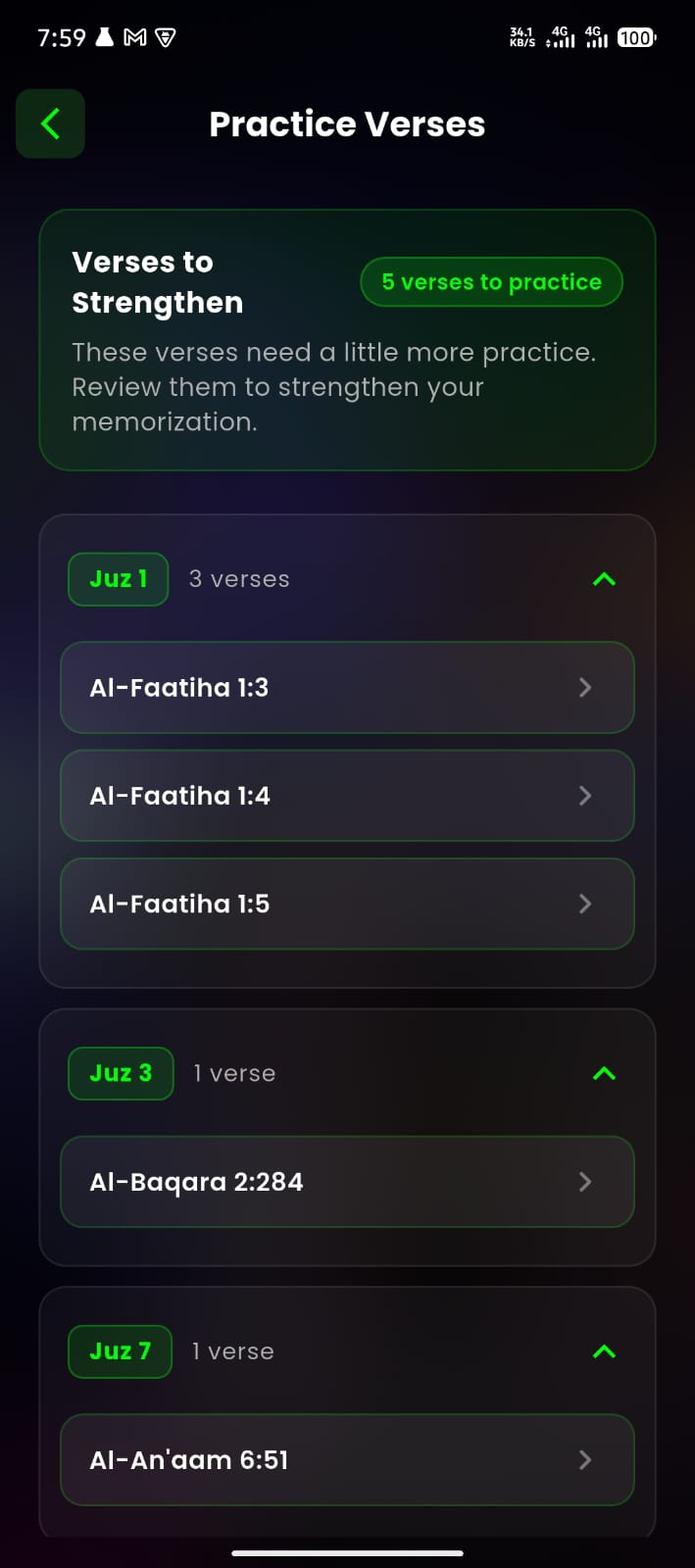
Practising alone has one weakness: you can't hear your own small mistakes. Hufaaz listens as you recite from memory, catches the exact ayah you get wrong, and plays it back correctly in your chosen Qari's voice, so you find the weak spots before salah does.
Conclusion
If your mind goes blank in salah, pause, repeat the last ayah, and move on if you need to. Your prayer isn't ruined.
To stop it happening, practise the way you pray: standing still, no mushaf, no warm-up. Build a small salah set, test the first lines, start from the middle, and recite to another person each week.
If you'd like a listener while you practise, Hufaaz is free on Google Play. May Allah make His words firm on your tongue whenever you stand before Him.