
Similar Verses in Juz 'Amma — and How to Stop Mixing Them Up
Juz 'Amma is full of near-identical verses that trip up new and advanced huffaz alike. Here are the most confusing similar passages and a simple method to keep them straight.
Juz 'Amma (the 30th juz) is where almost everyone begins their hifz — and where a lot of people hit their first wall. The surahs are short, but they're packed with verses that sound almost the same. You're reciting one surah, hit a familiar phrase, and suddenly find yourself finishing a completely different one.
These are the mutashabihat — the similar and repeated verses of the Qur'an. This guide covers the kinds that trip people up in Juz 'Amma and a simple method to keep them apart. (For the full picture of what mutashabihat are, see what are the mutashabihat.)
Why Juz 'Amma is so easy to mix up
Two things make this juz tricky:
- Repetition by design. Some verses are meant to repeat — that's part of the Qur'an's rhythm and message. Your memory hears the repetition and can lose count of which one it's on.
- Short, similar surahs. Many surahs share themes, openings, and endings, so their "shape" in your memory overlaps.
Neither is a flaw in you — it's the nature of the material. You just need to study the overlaps directly.
The famous one: "Then which of the favours..." isn't here — but repetition is
The clearest example of intentional repetition new memorizers meet is in Surah Al-Mursalat, where a refrain returns again and again between passages. Because the surrounding verses differ but the refrain is identical, it's very easy to jump from one section straight to another and skip the material in between.
The same pattern of repeated refrains and near-identical closings shows up across the juz. The trap is always the same: the repeated part is solid in your memory, but the part that tells you which repetition you're on is weak.
Watch the surah endings
A lot of confusion in Juz 'Amma comes from similar endings. Several short surahs close with verses about reward, punishment, or the Day of Judgement using overlapping wording. When two surahs end in a similar register, your memory can swap their final verses without any warning — because both are still perfectly fluent Qur'an.
The fix isn't to re-memorize the surahs. It's to study the confusing endings side by side so the difference becomes obvious.
The method: study the pair, not the page
You can't fix a mix-up by reviewing each surah on its own, because the confusion only lives between the two similar spots. Do this instead:
- Spot your specific pair. Everyone's trap verses are different — find the two spots you keep swapping.
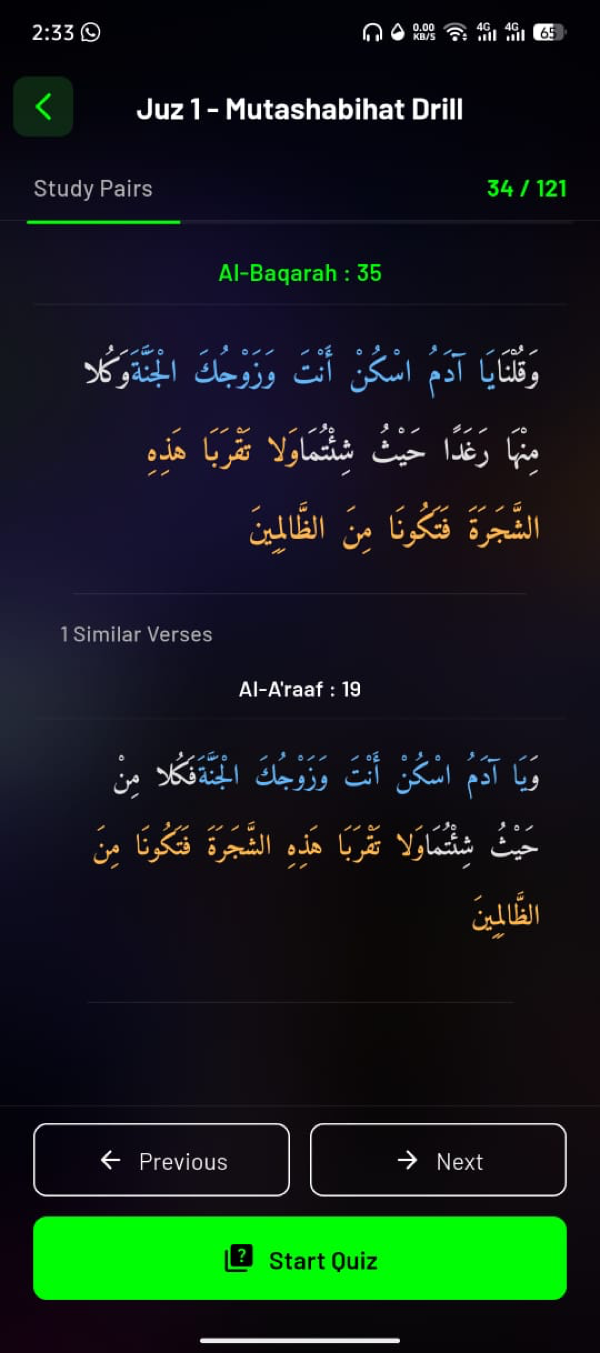
- Line them up side by side. Put the two verses next to each other so the difference jumps out.
- Anchor the difference. Give each a small mental hook — a word, an order, a meaning — that tells you which is which.
- Drill the fork. Practice deliberately reciting into each version, so your recall learns to take the right branch automatically.
The goal isn't memorizing both — you already have them. It's training the fork in the road.
Test yourself where the mistake hides
Ordinary review won't catch these, because you'll recite whichever version comes to mind and move on, feeling fine. You need testing aimed at the pair — something that flags the instant you take the wrong turn.
This is exactly what Hufaaz was built for. It puts the similar verses of Juz 'Amma side by side with the differences highlighted, drills the pairs you personally keep confusing, and — as you recite out loud — catches the precise moment you slip onto the wrong verse and corrects you in your chosen Qari's voice. It's the only app built specifically around the mutashabihat.
A few habits that help
- Keep your own list of the Juz 'Amma spots you confuse — and review the pairs, not just the surahs.
- Recite out loud, from memory. Silent reading hides these mistakes completely.
- Use spaced repetition. Bring a confused pair back just before you'd forget which is which.
Juz 'Amma feels deceptively simple until the similar verses start blurring together. Treat each mix-up as a specific fork in the road: find your pair, line them up, anchor the difference, and drill the switch. Do that, and the passages that used to derail you become the ones you recite with the most confidence.
Want an app that surfaces these pairs and catches the mistakes as you recite? Hufaaz is free on Google Play.