

How to Restart Hifz After a Long Break
Stopped memorizing for months or years? You haven't lost it all. A practical plan for returning to hifz — what to rebuild first, and a pace that lasts.
You memorized ten juz once. Or five. Or two. Then something happened — exams, a new job, a baby, an illness, a move — and the daily sitting stopped. Weeks became months. Now you open the mushaf, recite a page you once knew cold, and stumble on the third line.
The feeling that follows is almost always the same: I've lost it. I'd have to start from zero.
You almost certainly have not lost it, and you almost certainly do not have to start over. Memorized text that has faded is not the same as text you never learned. It is stored differently, and it comes back at a fraction of the original cost — often five to ten times faster than the first pass. This article is about how to return: how to find out what's actually still there, what to rebuild first, and how to set a pace that won't collapse the way the last attempt did.
First: what a "break" actually did to your hifz
When you stop reviewing, you don't lose the memorization in one piece. You lose fluency first — the effortless flow from one ayah to the next — while the underlying trace stays. That's why a page you haven't touched in two years feels unreachable when you try to recite it from memory, but feels startlingly familiar the moment you read the first line.
This distinction matters enormously, because it changes what the work is. You are not memorizing. You are re-fluencing. The words are in there; the path to them has grown over. Clearing a path is much less work than cutting a new one.
Two practical consequences follow:
- Do not restart from Surah al-Baqarah as though you never memorized. That wastes the most valuable asset you have.
- Do not judge your hifz by how it feels on day one. Day one is the worst it will ever be. The recovery curve is steep and fast in the first few weeks.
Step 1: Take an honest inventory (one sitting, no judgement)
Before you plan anything, find out what you're working with. Set aside one sitting and go through every juz or surah you ever memorized. For each one, recite from memory as far as you can and mark it into one of three buckets:
- Green — still there. You recite it with only occasional slips. It needs review, not relearning.
- Amber — shaky. You can get through it with prompts, but you stall at the page turns and the similar verses.
- Red — gone. You cannot begin it from memory without opening the mushaf.
Write the list down. This is the single most useful thing you will do, for two reasons. First, it converts a vague dread ("I've forgotten everything") into a specific, finite task — and it is almost always smaller than you feared. Second, it becomes your work queue.
Be honest in the marking. Grading a shaky juz as green is a favour to your ego and a debt to your future self.
Step 2: Rebuild the old before you add the new
This is the rule that separates a return that holds from one that collapses again in six weeks:
Add nothing new until your green and amber pages are firm.
The instinct on returning is to press forward — to feel like you're progressing, to get back to where you "should" be. Resist it. Every new page you memorize adds to the review load, and your review load is exactly what broke last time. Recovering old pages, by contrast, reduces future load: each juz you bring back to green is a juz that costs you minutes a day instead of an hour.
Work your list in this order:
- Green pages — a light review cycle, just to stop the slide. Cheapest work, highest return.
- Amber pages — the real project. Concentrated attention until they move to green.
- Red pages — treated as fresh memorization, but with a tailwind. You'll find these come back far faster than the first time.
Only when the list is green from top to bottom should you memorize anything new. For many returners this stage takes a few weeks; for someone coming back to a completed hifz after years away, it may take several months. Either way it is the foundation, and skipping it is why second attempts so often fail the same way the first did.
Step 3: Set a pace you'd keep on your worst week
Here is the uncomfortable truth about the break: in most cases it wasn't caused by weak memory or weak intention. It was caused by a schedule that only worked on good days.
A plan that requires ninety focused minutes will survive a normal week and die in a hard one — and hard weeks are not the exception, they're the pattern. Illness, deadlines, travel, a bad night with a newborn. The schedule that lasts is the one that still functions on your worst realistic day.
So set your daily minimum at a level that feels almost embarrassingly small:
- Fifteen minutes of review is a real commitment that survives almost anything.
- Half a page of relearning is meaningful progress in the amber stage.
- One page of green-list review takes a few minutes and keeps a juz from sliding.
Then treat that minimum as non-negotiable and everything above it as a bonus. On a good day, do more — nobody is stopping you. On a terrible day, do the fifteen minutes and go to bed having kept the chain intact. Consistency at a low level beats intensity that stops, every time, and it is the actual mechanism by which hifz is retained. (Our guide on staying consistent and motivated goes deeper on protecting the habit itself.)
Step 4: Expect the similar verses to be the hardest part
When hifz fades, the mutashabihat — the verses that resemble one another across the Qur'an — decay first and return last. Passages that differ by a single word, or by the order of two phrases, lose their distinctness the moment fluency drops. You will find yourself starting an ayah correctly, drifting into its twin somewhere else in the Qur'an, and finishing in the wrong surah entirely.
This is normal, it is not a sign that your memorization was poor, and it is the single most likely place for a returner to become discouraged. Treat these verses as a named category of work rather than as random failures:
- Mark every place you cross over between similar passages.
- Study the two versions side by side until you can articulate exactly what differs.
- Review them as pairs, deliberately, rather than hoping they'll sort themselves out in the flow.
Our article on what the mutashabihat are and how to stop confusing them covers the technique in detail, and similar verses in Juz 'Amma works through the specific cases most memorizers meet first.
Step 5: Get corrected — you cannot hear your own errors
After a long break, the most dangerous errors are the confident ones: the slips you make fluently, without hesitation, and therefore never notice. A word substituted for its synonym elsewhere in the Qur'an. A phrase order quietly reversed. Recited smoothly, they feel exactly like correct recitation from the inside.
Reciting to someone else is the classical solution and remains the best one — a teacher, a study partner, a family member following along in the mushaf. If you can arrange regular listening sessions, do it; nothing else matches a knowledgeable ear.
Where that isn't possible every day, the requirement doesn't go away, it just needs another route. Recording yourself and checking against the text catches some of it. Reciting with the mushaf open in front of a partner catches more. The point is simply this: do not spend months reinforcing an error you cannot hear. Rebuilding on top of wrong text costs far more to fix later than catching it now.
Step 6: Rebuild the surrounding habits, not just the recitation
The break was rarely only about the memorization. Usually the whole structure around it went — the time of day, the place, the mushaf you always used, the person you recited to.
Rebuild the structure and the recitation tends to follow:
- Fix the time. Attach the sitting to something that already happens daily — after Fajr, after Isha, the first fifteen minutes after the children are asleep. A floating "sometime today" is the first thing a busy day deletes.
- Fix the place. The same corner, the same posture. Environmental cues do a surprising amount of the work of starting.
- Use one mushaf. Page layout is part of how hifz is stored; switching prints costs you real recall.
- Recite in your salah. Working your recovering pages into your daily prayers gives them repetitions you'd otherwise have to schedule separately.
What a realistic first month looks like
To make it concrete, here is a shape that works for most people returning after a long gap:
Week 1 — inventory and habit only
Take the inventory, then a fifteen-minute daily review of your strongest green pages. Deliberately do no relearning at all. The goal this week is to restart the habit, not the syllabus.
Week 2 — add one amber page
Keep the green review going. Add a single amber page, worked slowly until it is solid. One page. Not five.
Weeks 3-4 — build the rhythm
Continue: green review daily, one amber page at a time, and begin marking mutashabihat crossings as you meet them. By the end of the month the green list should be genuinely firm and several amber pages should have moved across.
Notice what this month does not contain: new memorization, a dramatic catch-up plan, or any attempt to reach where you were before the break. Those come later, and they come much more easily once the foundation is real.
A word on the discouragement
Coming back is difficult in a way that starting was not. When you began, every page was progress. Returning, you spend weeks recovering ground you once held, and the whole time a voice suggests you're merely repairing your own negligence.
Two things worth holding onto.
First, the Prophet ﷺ described how readily the Qur'an slips away — "it escapes from memory faster than a camel escapes from its tying rope" (Bukhari and Muslim). This is the described nature of the thing, not a special failing in you. Every hafiz contends with it; you are simply contending with it after a longer gap.
Second, the difficulty is not a deduction from the reward. The one who struggles with the Qur'an and finds it hard was not left out — the Prophet ﷺ said such a person has two rewards. The weeks of recovery are not a penalty phase before the real work begins. They are the work, and they count.
You memorized it once. That version of you was not more capable than the one reading this — only less busy, or less tired, or luckier in circumstance. The pages are still there. Go and get them.
Frequently asked questions
Can I restart hifz after years away, or do I have to start over? You can restart, and you should not start over. Faded memorization is stored differently from text never learned, and it returns far faster than the first pass — often five to ten times faster. Begin by assessing what remains, then rebuild the weakest of your old pages before adding anything new.
How do I know how much Qur'an I still remember? Go through every juz you once memorized in a single sitting and sort each into three buckets: still solid, shaky but recoverable with prompts, and genuinely gone. Write the list down. It turns a vague fear of having lost everything into a specific, finite task — which is nearly always smaller than expected.
Should I review my old memorization or memorize new pages first? Review the old first, without exception. New pages add to your daily review load, and an unsustainable review load is what usually caused the break in the first place. Every old juz you restore to firmness actually reduces future work, making the return far more likely to hold.
Why do I keep mixing up similar verses after a break? The mutashabihat — verses that closely resemble one another — lose their distinctness first when fluency fades, because what separates them is often a single word or a reversed phrase order. This is expected after a gap, not a sign of poor memorization. Study the pairs side by side and review them deliberately as pairs.
How long does it take to recover hifz after a long break? It depends on how much you had and how long the gap was, but recovery is dramatically faster than original memorization. Many returners find their solid pages firm again within weeks. Someone rebuilding a completed hifz after years away should expect several months of focused review before adding new material.
How much should I do each day when restarting? Set a daily minimum small enough to survive your worst realistic week — fifteen minutes of review is a genuine commitment. Treat that as non-negotiable and anything beyond it as a bonus. Schedules that only work on good days are precisely what break, because hard weeks are the pattern, not the exception.
What if I keep restarting and stopping again? Look at the schedule rather than your intention. Repeated collapse almost always means the daily requirement was set for an ideal day. Cut the minimum until it feels almost too small, anchor it to something that already happens daily, and let consistency rebuild before increasing the load.
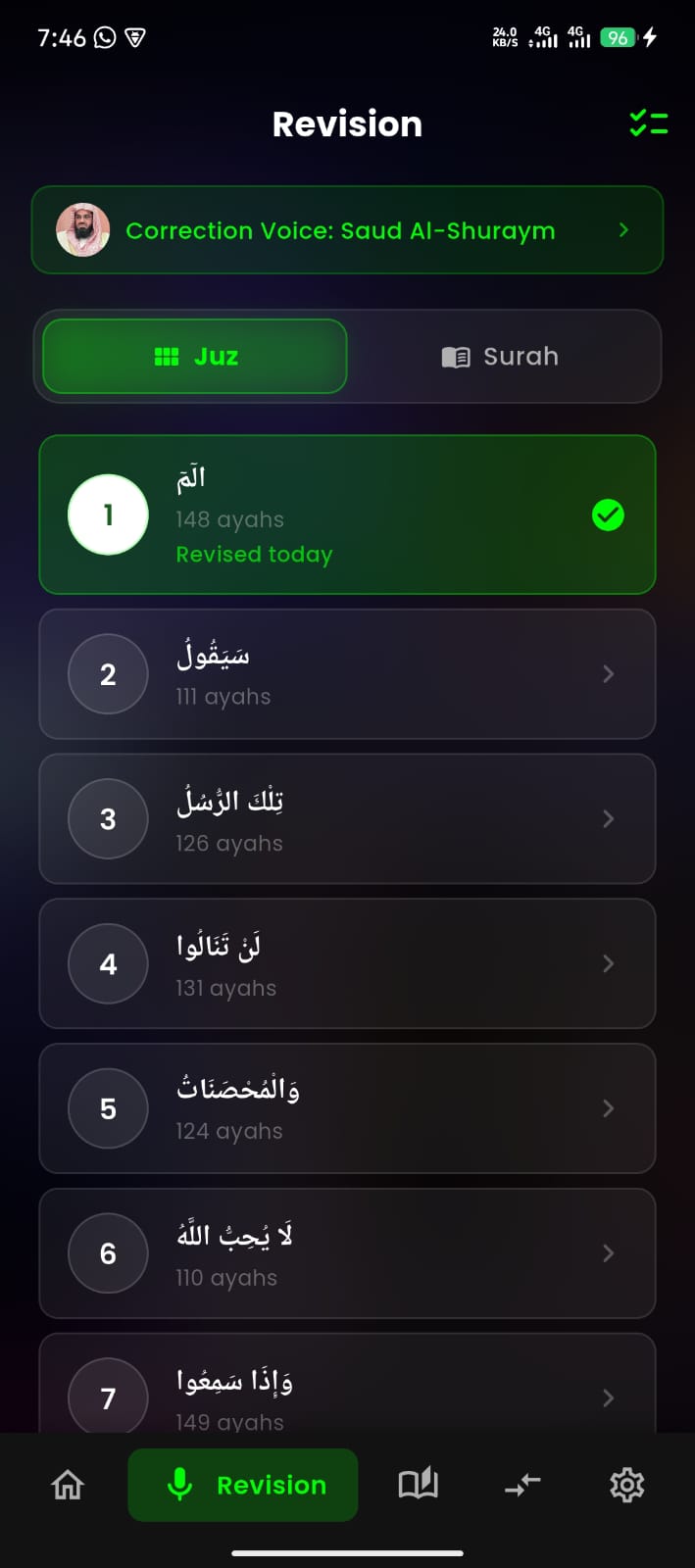
Returning is mostly a bookkeeping problem: knowing which juz are solid, which are shaky, which page is due next, and catching the confident errors you can no longer hear in your own recitation. Hufaaz is built for exactly that — it tracks what's firm and what's slipping, brings weak pages back sooner, and as you recite from memory it catches the precise word you slip on and corrects it in your chosen Qari's voice.
Conclusion
A break is not a verdict. It is a gap in a habit, and habits can be rebuilt — usually faster than the discouragement of day one suggests.
Take the inventory. Rebuild the old pages before adding new ones. Set a daily minimum you would keep on your worst week. Name the similar verses as their own work. Get corrected by someone who can hear what you cannot. Then let consistency do what it does.
If you'd like something to run the review cycle and track which pages are slipping, Hufaaz is free on Google Play. May Allah return to you what you once held, make it firm, and let none of it be lost.