

Why You Forget What You Memorized
Five real reasons memorized pages slip away, how to tell which one is yours, and the fix for each. Forgetting is normal — losing pages isn't.
You memorized the page. You were sure of it. Two weeks later you sit down to recite, and half of it is gone.
It's one of the most discouraging parts of hifz, and most people take it personally. They decide their memory is weak and they weren't built for this.
Almost always, that's the wrong conclusion. Forgetting is normal and expected — it's how memory works for everyone. But losing pages happens for specific reasons, and once you know which one is yours, you can fix it.
Here are the five real causes.
1. You're not reviewing enough
This is the big one. It explains most forgetting, and nothing else on this list comes close.
Your memory isn't a box where things stay once you put them in. Anything you don't go back to fades. That's not a flaw in you — it's how every human memory works, for phone numbers, faces and Qur'an alike.
New pages fade fastest of all. A page memorized today is fragile for the first few weeks, and needs revisiting almost daily to settle.
How to tell it's you: You can memorize fine, but older pages keep going soft while you move forward.
The fix: Build a proper review cycle instead of reviewing whatever comes to mind. The traditional system splits your hifz into three parts — today's new portion, recent pages, and older juz — and each gets time every day. Our revision schedule guide sets it out.
2. You memorized too much, too fast
Many people chase pages and feel good about the speed. Then it all unravels at once.
Here's why. Every page you memorize joins a review pile that only grows. Memorize a page a day and after four months you're holding roughly four juz — and reviewing four juz takes real time, daily, on top of the new page. Eventually the review alone fills your whole session, and something has to give.
Usually what gives is the review. Then the older pages go quiet.
How to tell it's you: Your review keeps falling behind no matter how you organise the day, and you feel permanently behind.
The fix: Slow the new memorization until your review fits comfortably. This feels like going backwards and isn't. How much to memorize per day helps you find a pace you can actually hold.
3. You were reading, not reciting
This one catches people who are working hard and can't understand why it isn't sticking.
Reading a page over and over builds recognition — you know the words when you see them. Hifz needs recall, which is producing the words with nothing in front of you. Those are two different skills.
With the mushaf open, you feel confident. The page is right there, feeding you the next word before you notice. Close it, and there's nothing.
How to tell it's you: You can recite smoothly while glancing at the page, but stumble badly without it.
The fix: Close the mushaf. Recite out loud from memory, and let yourself get stuck. The places you hesitate are the parts you don't actually have — and you'll never find them with the page open. This is one of the most common mistakes in hifz.
4. The verses are similar to other verses
Sometimes a page isn't fading at all. Your memory is simply taking a wrong turn.
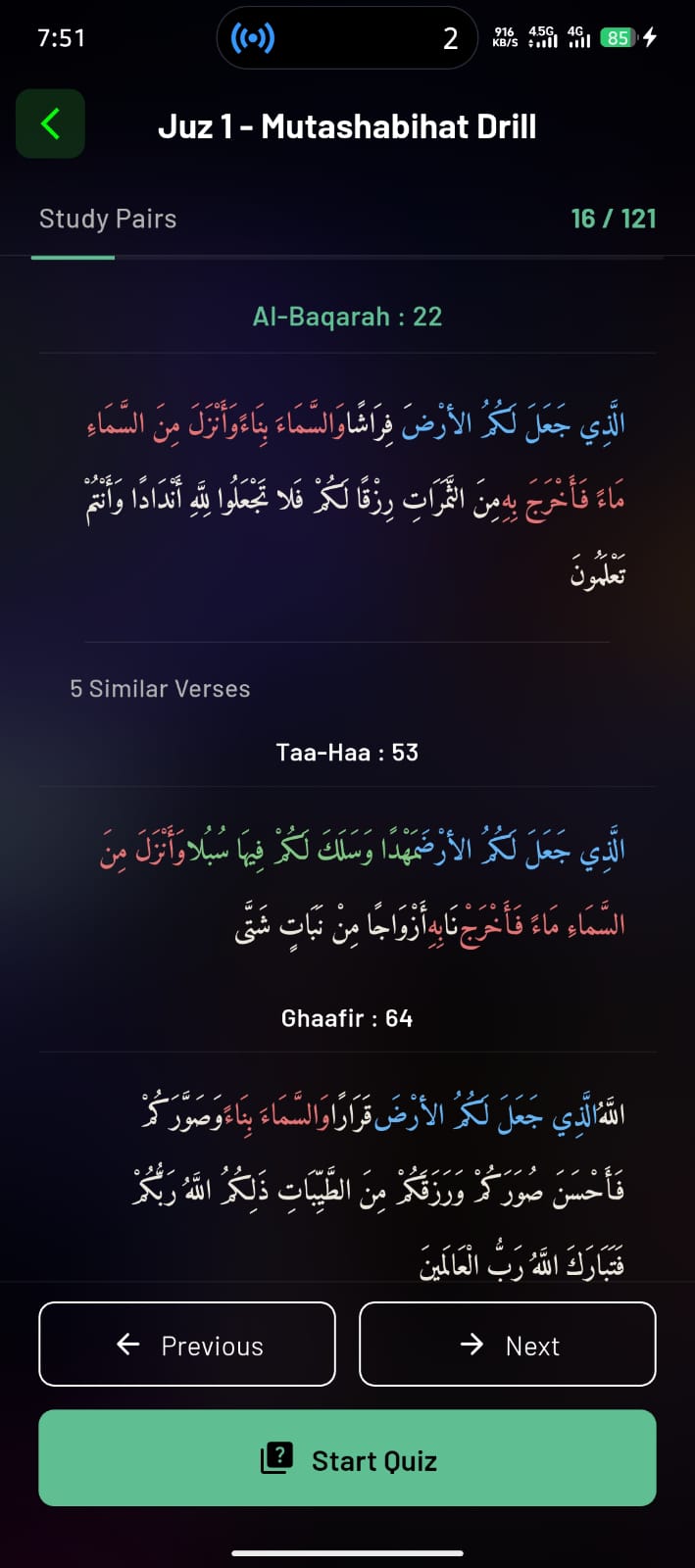
The Qur'an has many passages that look and sound almost identical, with small differences — one word changed, a different order, an extra phrase. These are called the mutashabihat. Your memory stores them in the same place, so when you reach that point you slide into the wrong one and carry on happily, not realising.
This feels like forgetting. It isn't. The material is there; the path to it is crossed.
How to tell it's you: You don't blank — you recite confidently and end up in a different surah or passage.
The fix: Different problem, different method. You need to study the similar pairs side by side and mark exactly what differs. What the mutashabihat are covers the technique, and similar verses in Juz 'Amma handles the ones beginners hit first.
5. You stopped for a while
A gap of a few weeks does more damage than people expect, and it hits recent pages hardest.
Life causes this — exams, illness, travel, a new baby. It's not a character failure. But the cost is real, and the usual response makes it worse: people feel bad, put off restarting because the hole looks huge, and the gap grows.
How to tell it's you: You know exactly when you stopped, and the pages from around that time are the weakest.
The fix: Go back sooner and smaller than feels right. Fifteen minutes of review beats waiting for a day when you can do an hour. And next time life gets heavy, don't stop — shrink. Drop the new pages, keep a short daily review. How to restart after a long break walks through coming back without starting over.
Forgetting is not a sign you're failing
Worth saying plainly, because this is where people give up.
Even the Prophet ﷺ described this as part of the human condition:
"It is wretched for any of you to say, 'I have forgotten such and such a verse,' rather he has been made to forget." — Sahih al-Bukhari 5032
He ﷺ also said:
"Keep refreshing your knowledge of the Qur'an, for I swear by Him in whose hand my soul is, it is more liable to escape than camels which are tethered." — Sahih al-Bukhari 5033; Sahih Muslim 791
Look at what that comparison says. The Qur'an slipping away isn't described as unusual or shameful — it's the expected thing, which is exactly why constant review is commanded. The instruction assumes you'd forget without it.
So if pages are fading, you aren't doing something strange. You're meeting the normal condition of every hafiz, and the answer is the one the hadith gives: keep going back to it.
Which one is yours?
Quick way to check:
| What you notice | Likely cause |
|---|---|
| Old pages fade while new ones go in fine | Not enough review |
| Review never fits, always behind | Memorizing too fast |
| Fine with the page open, lost without it | Reading, not reciting |
| You recite confidently into the wrong passage | Similar verses |
| Weakest pages are from before a break | A gap |
Most people have one main cause and a bit of a second. Fix the main one first.
Frequently asked questions
Why do I forget what I memorized from the Qur'an? Usually because of not enough review — memory fades for everyone unless you go back to it, and new pages fade fastest. The other common causes are memorizing faster than you can review, practising with the page open instead of from memory, mixing up similar verses, and taking a long break.
Is forgetting the Qur'an normal? Yes. The Prophet ﷺ compared the Qur'an to tethered camels that escape easily (Sahih al-Bukhari 5033), which tells us forgetting is the expected condition rather than a personal failing. That's exactly why regular review is part of hifz rather than an optional extra.
How do I stop forgetting what I memorize? Build a structured review cycle covering today's portion, recent pages and older juz, and recite from memory with the mushaf closed rather than reading along. If your review keeps falling behind, slow your new memorization until the two balance.
Why can I recite with the mushaf open but not from memory? Because reading builds recognition while hifz needs recall, and they're different skills. With the page open it feeds you the next word before you notice. Close it and recite aloud — the places you hesitate are the parts you don't yet have.
I keep ending up in the wrong verse. Is that forgetting? No, that's the mutashabihat — passages that look and sound almost the same with small differences. Your memory takes a wrong turn rather than losing the material. It needs a different fix: study the similar pairs side by side and mark exactly what differs.
How long does it take to forget a memorized page? New pages are fragile for the first few weeks and can fade noticeably within days without review. Pages you've held for years are far more stable, but they still soften over months if you never return to them.
I stopped for months. Have I lost everything? Almost certainly not. Memorized material usually sits dormant rather than disappearing, and most people recover old pages far faster than they first learned them. Restart smaller and sooner than feels right rather than waiting for a clear day.
Most pages don't vanish suddenly — they soften quietly, and you find out weeks later. Hufaaz tracks what's due and what's slipping, brings weak pages back sooner, and as you recite from memory it catches the exact word you stumble on and corrects it in your chosen Qari's voice.
Conclusion
Forgetting doesn't mean your memory is poor or that hifz isn't for you. It means you're human, and the hadith about tethered camels says as much.
Work out which of the five causes is yours. Then fix that one — build the review cycle, slow the pace, close the mushaf, study the similar verses, or restart smaller. One change in the right place usually settles most of it.
If you'd like something tracking what's due while you get on with reciting, Hufaaz is free on Google Play. May Allah keep His book firm in your heart.