
How to Read Qur'an Every Day (Even When You're Busy)
You don't need an hour a day. A simple way to build a daily Qur'an habit that lasts, with a pace table for finishing a khatm and what to do when you miss a day.
Most of us have made the same promise many times: this time I'm going to read Qur'an every day. It goes well for a week, maybe two. Then work gets busy, a few days slip by, and the mushaf goes back on the shelf until Ramadan.
If that sounds familiar, the problem usually isn't your iman or your willpower. It's the plan. Big goals feel inspiring on day one and heavy by day ten.
Here's a gentler way to make reading Qur'an a daily habit that actually sticks.
Small and daily beats big and rare
The Prophet (peace be upon him) was asked which deeds are most loved by Allah. He said: the ones done regularly, even if they are small (Sahih al-Bukhari 6464).
This is the whole secret of a lasting Qur'an habit. One page every day for a year is far more than thirty pages once a month and then nothing.
And no reading is too small to count. The Prophet (peace be upon him) said that whoever reads a letter from the Book of Allah gets a good deed, and each good deed is multiplied ten times (Jami' at-Tirmidhi 2910). Even five minutes is worth showing up for.
Step 1: Start smaller than you think
Pick an amount so small it feels almost too easy:
- One page a day, or
- Five minutes a day, or
- Ten ayahs a day
You can always read more on good days. But your minimum should be something you can do on your worst day: when you're tired, ill, or travelling. That minimum is what keeps the habit alive.
Step 2: Tie it to a salah
The easiest way to remember a new habit is to attach it to something you already do. For most Muslims, that's salah.
Choose one prayer and read right after it, before you get up. After Fajr works well for many people because the house is quiet and the day hasn't started yet. If mornings are a rush, after Isha or Maghrib is just as good. If you're not sure which time suits you, this guide to the best time of day can help.
The key is the same time every day, so it stops being a decision.
Step 3: Make it easy to start
Small things make a big difference:
- Keep the mushaf where you pray. If it's on a high shelf in another room, you'll skip it more often.
- Use a bookmark. Knowing exactly where you stopped removes the "where was I?" moment.
- Have a backup. Keep a Qur'an app on your phone for days when you're away from home.
Step 4: Choose a pace that fits your goal
If you'd like to finish the whole Qur'an (a khatm), here's how long it takes at different daily paces. The standard mushaf has 604 pages.
| Pages per day | Time to finish the Qur'an |
|---|---|
| 1 page | about 20 months |
| 2 pages | about 10 months |
| 5 pages (one after each salah) | about 4 months |
| 10 pages | about 2 months |
| 20 pages (one juz) | about a month |
The "one page after each salah" plan is a favourite. Each sitting is only two or three minutes, but it adds up to five pages a day and a full khatm in about four months.
If you're new to reading Qur'an, there's no rush. Start at one page and move up only when it feels easy.
Step 5: Understand a little of what you read
Reading in Arabic is rewarded even if you don't understand it. But many people find that their habit gets much stronger once the words start to mean something.
Try this: after your daily reading, read the translation of just one ayah you recited. Over a year, that's 365 ayahs you've understood, and the Qur'an starts to feel personal instead of distant.
Step 6: Listen when you can't read
Some days you won't be able to sit down with the mushaf. On those days, listen instead:
- During your commute
- While cooking or doing chores
- Before sleeping
Listening isn't a replacement for reading, but it keeps you connected on busy days. It also improves your pronunciation, because you hear how the words should sound. If your recitation needs work, tajweed for beginners is a good place to start.
Step 7: Track it, gently
Seeing a row of days you showed up is surprisingly motivating. You can use a simple calendar on the wall, a note on your phone, or an app with a streak.
Just don't let the streak become the goal. The goal is the Qur'an. The streak is only a reminder.
What to do when you miss a day
You will miss days. Everyone does. What matters is what happens next.
Never miss twice. One missed day is a slip. Two in a row is the start of a new habit, the wrong one. If you missed yesterday, read your minimum today, even if it's only a few ayahs.
Don't try to "catch up." If you missed three days, don't try to read four days' worth today. That turns your habit into a debt, and debts feel heavy. Just read today's portion and carry on.
Lower the bar for a while. If life is hard right now, drop to half a page a day. A smaller habit you keep is better than a bigger one you abandon.
Going further: from reading to memorizing
Once daily reading feels natural, many people want to take the next step and start memorizing. The habit you've built is exactly what hifz needs: a fixed time, a small daily amount, and the patience to keep going.
When you're ready, where to start memorizing the Qur'an and how to stay consistent and motivated in hifz are good next reads.
Frequently asked questions
How much Qur'an should I read every day? Start with an amount you can manage even on your busiest day, such as one page or five minutes. Consistency matters more than quantity. You can increase it once the habit feels easy.
How long does it take to finish the Qur'an reading one page a day? The standard mushaf has 604 pages, so one page a day takes about 20 months. Reading one page after each of the five daily prayers finishes it in about four months.
What is the best time to read Qur'an daily? Any time you can keep every day. Many people find right after Fajr works best because it's quiet. Tying your reading to a specific salah makes it much easier to remember.
How do I stay consistent with reading Qur'an? Keep your daily minimum small, read at the same time each day, keep the mushaf where you pray, and never miss two days in a row. Tracking your days can help too.
Is listening to Qur'an the same as reading it? Listening attentively is a good deed, and it's a great way to stay connected on busy days. But reading the words yourself is a separate act of worship, so try to read at least a little each day too.
What should I do if I've stopped reading Qur'an for a long time? Start again today with a very small amount, like one page. Don't try to make up for lost time. If you had memorized and want to get it back, see how to restart hifz after a long break.
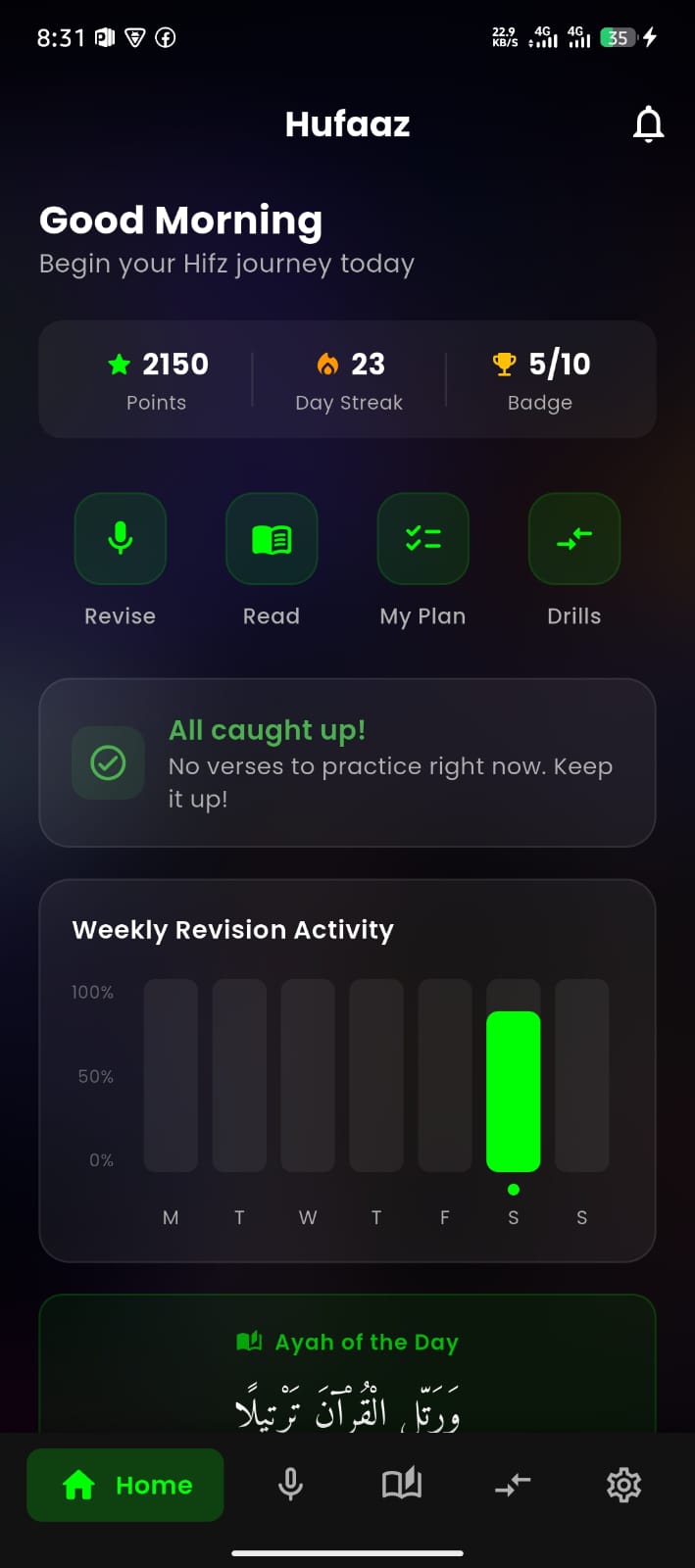
Hufaaz can support a daily habit in a few simple ways. It has a clean mushaf with tajweed rules colour-marked in the text, and the screen stays on while you read. You can set daily reminders for the times that suit you, track your streak, and listen to well-known reciters at your own speed when you can't sit down to read.
Conclusion
A daily Qur'an habit doesn't need an hour a day. It needs a small minimum, a fixed time after one of your prayers, an open mushaf within reach, and the decision to never miss twice. Start smaller than you think, and let the habit grow on its own.
If a reminder and a streak would help you show up each day, Hufaaz is free to download on Google Play. May Allah make the Qur'an the spring of your heart and a daily companion for the rest of your life.